

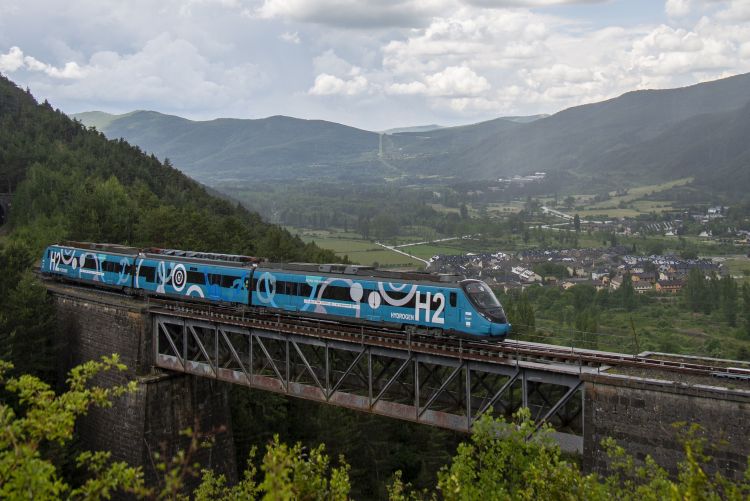
The FCH2Rail project has completed testing of its hydrogen-powered train on Spanish and Portuguese railway networks.
This bi-mode demonstrator train integrates a Fuel Cell Hybrid PowerPack, combining hydrogen fuel cells and batteries to power the vehicle on non-electrified lines, with the ability to switch to overhead electric power where available. The initiative, which began in January 2021, was developed by a consortium of partners, including CAF, DLR, Toyota, Renfe, Adif, CNH2, IP, and Stemmann-Technik, with a budget of 14 million euros, largely funded by European programs.
The project involved adapting an existing Renfe commuter train with a zero-emission power generation system. The initial phase included development and testing of the Fuel Cell Hybrid PowerPack outside the vehicle to optimize the energy management system. Following its integration, static tests were conducted at CAF’s Zaragoza facility in 2022, verifying system interfaces and performing hydrogen refueling and tightness checks.
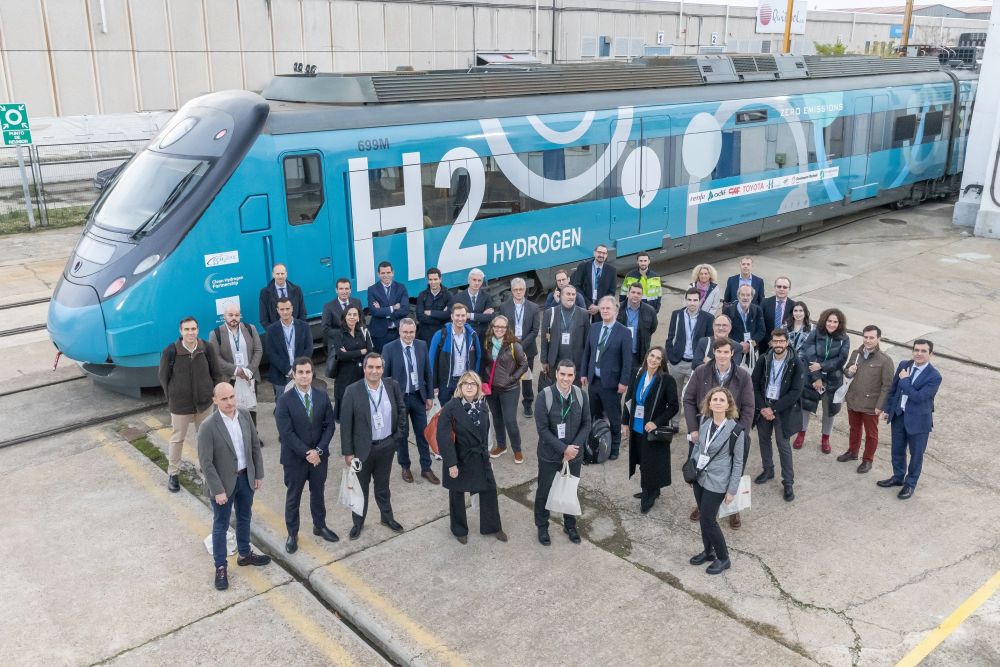
Dynamic testing commenced on closed tracks before moving to national routes. One of the notable stages involved test runs on the Zaragoza-Canfranc route in the Aragonese Pyrenees, marking Adif’s first authorization for hydrogen-powered train operations. The train was also tested on various routes across Aragon, Madrid, and Galicia, accumulating over 10,000 km in hydrogen mode under diverse operational and climatic conditions. The project reached another milestone when the train operated on a Portuguese route, providing further insight into its potential as a sustainable alternative to diesel-powered traction.
The FCH2Rail project’s achievements also extend to contributions in European rail standardization efforts, supporting the integration of hydrogen and fuel cell technologies into rail networks. By examining the feasibility and operational capacity of bi-mode propulsion, the project has provided a foundation for further evaluation of hydrogen-based solutions in rail transport.