

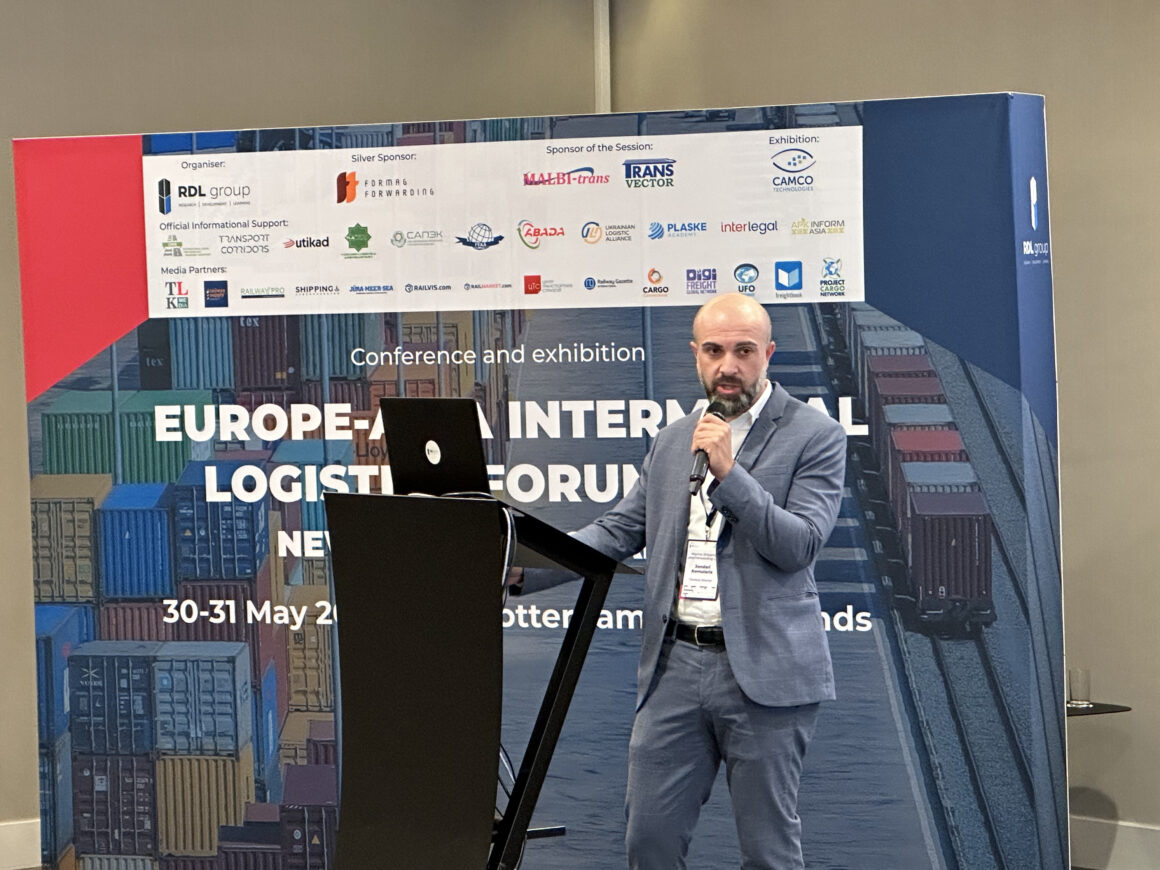
Jondari Kemularia, General Director of Marine Shipping and Forwarding LTD, noted that Georgia enjoys a high strategic position as a gateway to the Caucasus and Central Asia. It is a reliable transit corridor for the free movement of goods between the Caucasus and Europe, as well as between European countries and Central Asia. The Georgian transport economy is mainly transit-oriented.
One of the key topics of discussion today is unlocking the potential of the Middle Corridor, also known as the Trans-Caspian International Transport Route. This strategic transit route connects China with Europe, Central Asia, the Caspian Sea, the Caucasus and Turkey, helping to deepen economic and geopolitical ties between Asia and Europe.
The historical significance of this route lies in its ability to facilitate trade, cultural exchange and communication between East and West over the centuries. The modern Middle Corridor develops on the basis of ancient trade routes, and its creation at the beginning of the 21st century was a response to the need to diversify transit routes and increase trade volumes between Europe and Asia.
Key milestones in the formation of the Middle Corridor were initial discussions and agreements in 2000 among countries along the route, as well as the formal establishment of the Trans-Caspian International Transport Route in 2013. An important event was the opening of the Baku-Tbilisi-Kars railway line in 2016, which significantly strengthened the route’s connectivity.
The Northern Corridor represents a promising option for international trade as it boasts a fully unimodal transport system that significantly reduces transit time and costs. Its vast capacity exceeds that of the Middle Corridor, although efforts are being made to improve the latter’s infrastructure, including ports such as Aleppo and Baghdad, which are critical to connections with Europe. What is important here is rapid development with a focus on modern capabilities and innovation to meet growing needs.
“However, despite these achievements, the Northern Corridor faces challenges such as harsh winter conditions that can impact transit reliability, unlike the more stable Middle Corridor. Geopolitical stability along the Middle Corridor, especially highlighted by recent events in Tbilisi and Georgia, provides a secure route for trade, which is of paramount importance for shippers and logistics companies seeking to minimize risks,” shared Jondari Kemularia.
In addition, the Middle Corridor offers shorter transit times compared to sea routes, making it the preferred choice for urgent cargo between Europe and Asia. Its avoidance of regions prone to geopolitical tensions increases its appeal by reassuring stakeholders of the security of their supplies. As these corridors develop, the balance between infrastructure development, stability and efficiency will determine their competitiveness in the global trading environment.
The Middle Corridor provides a critical alternative to sea routes, significantly reducing transit times between China and Europe to around 15-20 days compared to 40-45 days by sea. Recent infrastructure improvements, such as the expansion of ports in Aktau and Baku, along with ongoing efforts to modernize railway networks in Kazakhstan, Azerbaijan and Georgia, have increased its efficiency and capacity.
Before the conflict in Ukraine, cargo volumes along the Middle Corridor were 15% lower than current figures: in 2023 alone, about 2.5 million tons of cargo were transported along it. The corridor’s improved infrastructure has resulted in noticeable reductions in transit times, benefiting both shippers and logistics providers seeking reliable and faster transportation options.
“Further development plans include completing the modernization of the Georgian railway by 2025, which promises to further optimize communications and reduce transit times within the region. The 15% increase in train traffic compared to last year underscores the growing importance of the corridor as a resilient route in the face of global disruption, increasing its attractiveness for international trade.”, spoke about future plans Jondari Kemularia.
Through continuous improvements and strategic expansion, the Middle Corridor continues to emerge as a key route offering diversified and secure alternatives to traditional shipping routes, which is critical to reducing risk and ensuring the smooth flow of global trade.
The company stresses that while container aircraft are often seen as the primary option for urgent deliveries, MSF has proven the reliability of container trains along the Middle Corridor. Despite periodic delays in transit, the corridor offers competitive freight rates to meet customer needs and ensure cargo safety.