

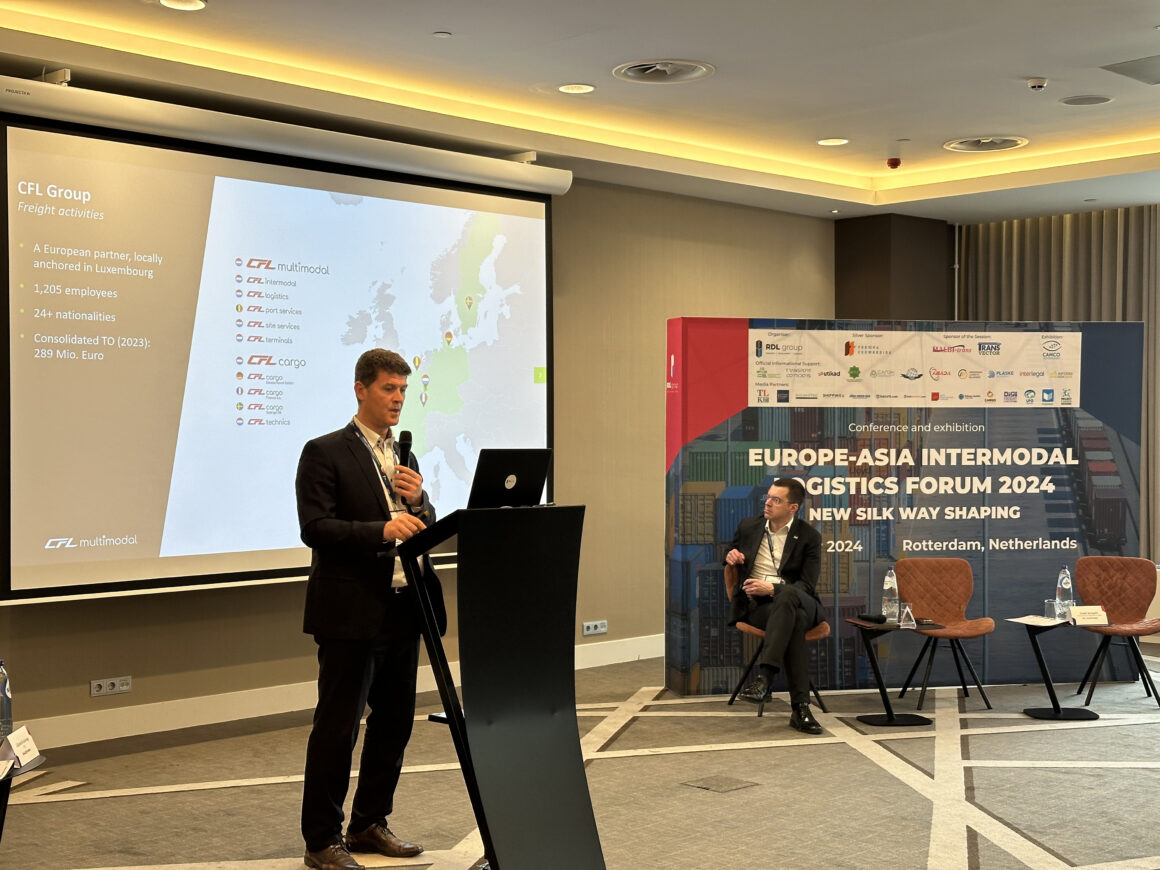
Imad Jenayeh, Senior Business Development Manager at CFL multimodal, provided an overview of the CFL Group structure in a European context and highlighted some of the solutions that improve workflows and competitiveness.
The CFL Group includes two main groups of companies: CFL Cargo and CFL multimodal. CFL Cargo, a joint venture between Arsenal of Italy and CFL, handles traction, operational condition, maintenance and has licenses and resources in five European countries. Meanwhile, CFL multimodal, a 100% subsidiary of CFL, manages intermodal operations, logistics, including road, housing, customs and terminal activities.
“Our group of 1,200 people from more than 24 nationalities serves the European community, demonstrating diversity and ability to serve different nationalities and countries. Having started our activities with the railway business, we have expanded the scope of our activities to include water, road and rail modes of transport, establishing an integrated approach to transportation.
Our activities are divided into three main areas: logistics, intermodal operations and terminal activities. In logistics, we offer door-to-door solutions using our road department and warehouses for storage and transhipment. GDP certification allows us to serve pharmaceutical clients, and our customs agency ensures smooth intercontinental business operations, assisting clients with imports from around the world,” Imad Jenayeh introduced the company.
The infrastructure component of CFL primarily covers terminal activities, while the rail segment covers traditional and intermodal transportation. Intermodal efforts aim to link Europe’s major economic centers and ports, forming a strategic network resembling a spider’s web.
While each country claims a central position, the CFN strategically connects key ports such as the Nordic ports of Germany and Antwerp, and attempts to integrate Rotterdam have been thwarted by short distances and low road prices, which hamper competitiveness. However, hopes lie in future emissions trading systems, potentially incentivizing rail transport through monetized bonuses.
CFL, while maintaining its European identity, strategically selects connection points to offer Eurasian operators access to its network, facilitating collaboration without duplication. While the industry has traditionally favored block trains, CFL champions network and technology readiness to facilitate efficient connections between Europe and Asia.
An exemplary success story is the Luxembourg – Le Boulou link, which spans over 1,000 kilometres, initially operating three times a week and now increasing to four times a day. This route boasts one of the longest trains in Europe, measuring 850 meters in length and accommodating a varied range of freight.
A striking example of CFL’s activities is also the direct connection between Sete and Poland, facilitated by partnerships with such large companies as IKEA and Inditex. Inditex in particular uses this route to import products from abroad, primarily China, process them in distribution centers in Spain and distribute them throughout Europe.
CFL’s strategy, based on Luxembourg’s strategic location between major players, focuses on niche markets such as semi-trailers. This specialization requires automation to remain competitive in the container handling and shipping industry. Future projects include connecting Romania and Hungary with Luxembourg, expanding services to Turkey via Constanta and establishing Middle Corridor connections with existing routes to Poznan and Russia.
In terms of infrastructure, CFL boasts a 33-hectare integrated logistics park, a significant portion of which is dedicated to semi-trailer parking. The terminal is equipped with fully automated cargo cranes and horizontal handling solutions, ensuring efficiency even for non-codified and non-collapsible semi-trailers. Recognizing the continued importance of semi-trailers in European logistics, CFL is committed to meeting growing volumes and introducing different solutions to handle different loading units.
To optimize terminal operations, CFL is implementing IT solutions, including a terminal operating system (TOS) and a vehicle reservation system, streamlining processes and increasing efficiency for all stakeholders involved in terminal operations.
CFL’s commitment to efficiency and customer satisfaction is demonstrated through innovative solutions and attention to employee well-being. The vehicle reservation system serves as an interface for drivers, providing real-time updates on the status of their loading units, thereby minimizing queues and optimizing resource utilization. The value-added services provided by Camco further enhance customer resource management.
Road and rail entry gate systems provide thorough documentation of the status of loading units, reducing disputes over damage and increasing safety. CFL’s proactive approach extends to codification efforts aimed at standardizing methods for identifying non-collapsible semi-trailers, facilitating efficient tracking and management.
“The tragic accident on the Denmark-Europe Bridge prompted CFL to innovate, resulting in the development of Block E, an additional sensor installed in pocket cars to monitor the locking of the king pin. The invention followed a fatal incident in which a wind-uplifted trailer collided with a passenger train, resulting in the bridge being closed to carriage traffic while an investigation was conducted.
The E Block provides real-time data to operators and customers, providing safety and automation through a simple interface indicating kingpin locking status. Recognizing the importance of rail safety, CFL received the Innovation Award for this system despite competing solutions,” shared Imad Jenayeh.
CFL’s commitment to safety also extends to the implementation of automated damage inspection (ADI) systems for semi-trailers, using camera technology to improve efficiency during technical inspections. While automating container inspection is a relatively simple task, semi-trailers present a more complex challenge, requiring ongoing efforts to implement an ADI system for a smoother workflow and improved customer service.