

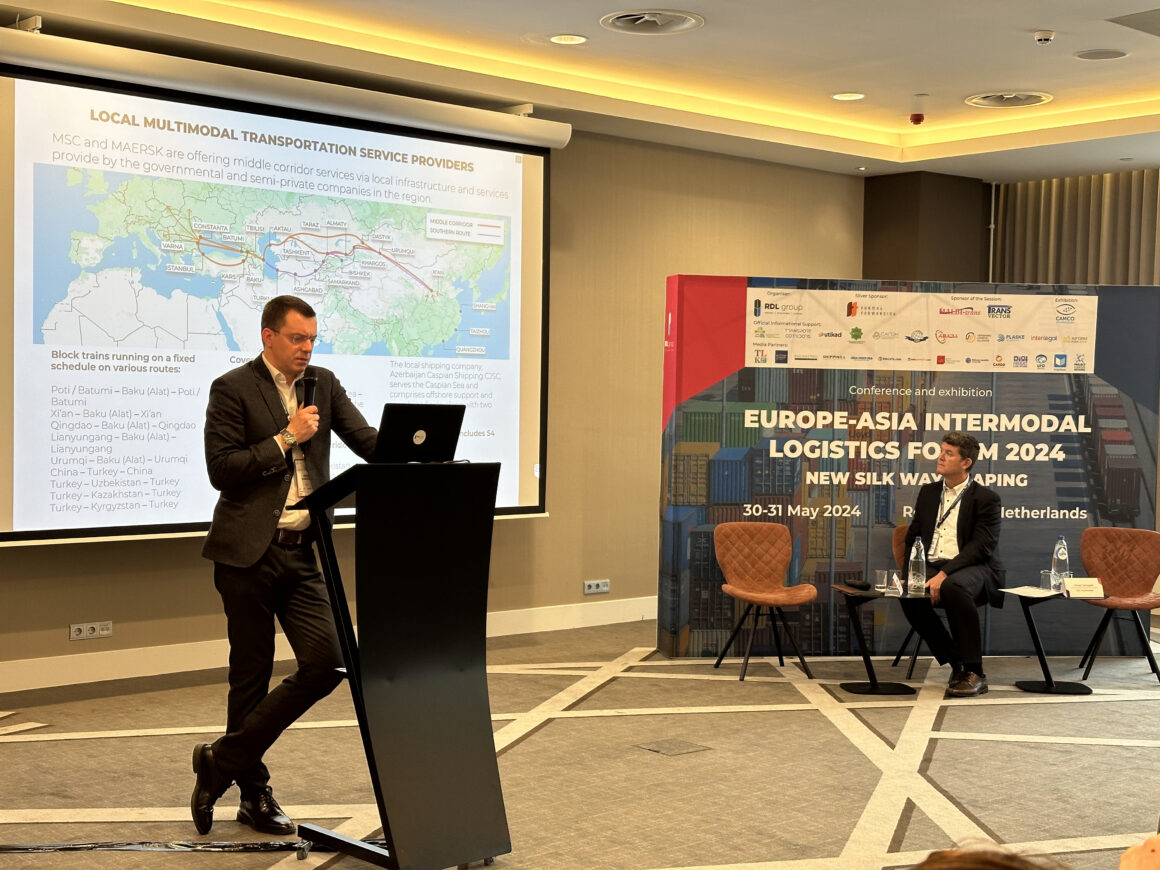
Oleg Kostyuk, CEO of GTI’n’FORMAG FORWARDING, said that the company, founded in 1992 in Odessa, Ukraine, Global Transport Investment (GTI) has grown into a conglomerate of 24 companies employing over 600 people and boasting a diverse portfolio in the transport and logistics sector. Among its subsidiaries, Formag Forwarding stands out as a renowned brand with operations spanning Azerbaijan, Kazakhstan, Georgia, Uzbekistan and Vietnam, and is also present in Ukraine, Poland, Bulgaria, Romania and Moldova, strategically connecting Europe and Central Asia.
Specializing in multimodal transport solutions, GTI offers comprehensive services including liquid cargo transportation through its fleet of trucks and tank containers, project logistics, agricultural logistics and even military exercise support. As the agency of Bulkhaul, the leading owner and operator of ISO Tank, GTI represents their interests in the Central Asian countries, offering solutions for the transportation of liquid cargo in Eastern Europe through joint efforts with Bulkhaul.
Focused on providing customized solutions for its clients, GTI leverages its extensive network and expertise to solve the complex logistics challenges associated with liquid bulk transportation, providing efficient and reliable services across a variety of industries and geographies.
Oleg Kostyuk then shifted his focus to infrastructure, highlighting key regions such as the Black and Caspian Seas, as well as connections between China and Central Asian countries. It is noteworthy that Georgia is becoming an important player in the Black Sea region, with major ports experiencing significant growth in container traffic. Last year, Georgia’s container traffic grew by almost 50%, while Romania and Bulgaria also recorded notable growth of 15% and almost 10% respectively.
“Critical for container and ferry transport, the Middle Corridor serves as a vital link between Europe and the Caucasus region. Turkey, especially Istanbul, plays a key role in this corridor, although specific data on the distribution of freight traffic between the Middle Corridor and local Turkish cargo remains elusive.
Moving on to the Caspian Sea, the ports of Baku and Aktau stand out for their regular flights, and the transit time between Aktau and Baku is 30 hours. The region has seen significant growth in container, ferry, freight and semi-trailer transport, reflecting growing trade volumes.
Finally, ties between China and Central Asian countries, especially Kazakhstan and Uzbekistan, highlight the growing importance of the Aktau port. In 2022, the total cargo turnover of the Aktau port reached 4.7 million tons, with containers accounting for 40% of the total. However, there are concerns about the efficiency of the infrastructure: the average container dwell time at the port of Aktau is seven days, indicating a potential area for improvement in the future,” Oleg Kostyuk shared.
Global carriers are significantly expanding their presence in the Caucasus and Central Asia, a recent study has found. While carriers such as CMA and MSC typically have a presence in Georgia, their presence in countries such as Azerbaijan, Kazakhstan and Uzbekistan is less typical. These carriers strategically position themselves with marketing departments and warehouses in these regions to better serve customers and optimize equipment utilization.
Railway infrastructure is critical to the development of freight flows along the Middle Corridor. However, some areas, especially those passing through Turkey with China into Central Asia, are experiencing congestion close to maximum capacity. Despite this, various railway development projects are either on paper or underway, indicating ongoing investment in the region’s transport infrastructure.
If we focus on Georgia, which serves as a prime example, there is an imbalance in container turnover: 80% is imported and only 12% is exported. This discrepancy highlights the country’s dependence on trade with its neighbors, especially Azerbaijan and other Central Asian countries.
In terms of trade routes, the US east and west coasts contribute significantly to Georgia’s container trade. In addition, trade with India and the Far East, especially China, is significant. The Far Eastern trade route to Georgia is divided between sea routes and a land bridge passing through Central Asian countries, highlighting the importance of multiple modes of transport in facilitating global trade.
“The recent crisis in the Red Sea has had a significant impact on trade dynamics, particularly affecting transit times from Far Eastern ports to Poti, increasing them to approximately 90 days, thereby reducing competitiveness. However, a land bridge from China to Central Asia to Georgia has proven to be a more competitive alternative, both in terms of price and transit time.
According to the World Bank, cargo volumes along the Middle Corridor are projected to triple from 2022 to 2030, indicating a significant shift in the structure of cargo flows. Traditional goods such as agricultural products, grain, food, minerals, fertilizers and oil continue to dominate, while the amount of liquid cargo transported by road is noticeably increasing,” noted Oleg Kostyuk.
The dynamics of container trade between Aktau and Baku showed significant growth: an increase of 33% was recorded in 2022, and similar volumes remained in 2023, especially for container cargo.
As a conclusion, Oleg Kostyuk said that it is expected that trade routes from China to Europe and back, both in the western and eastern directions, will experience stable growth, driven by an increase in Chinese exports to the European Union. However, containerization is becoming increasingly common due to its efficiency and safety in multimodal transport, leading to a surge in demand, especially in developing regions.
Oil stands out as the main commodity in westbound trade, followed by containerized oil. This highlights the urgent need for infrastructure to be ready to handle the growing volume of containers expected over the next five years. In this context, local multimodal transport is extremely important, since numerous multimodal railways directly connect China, Kazakhstan, Azerbaijan and Georgia. These services make it easy to load goods into containers, and the multimodal operator takes care of the rest. However, problems persist at border crossings and ports due to congestion.
“For example, the throughput of the port of Poti has reached 95% of container turnover, which indicates limited opportunities for further growth, especially for Georgia. Development projects are critical to addressing these limitations. While numerous investment and development projects are underway along the Middle Corridor, some highlights include Baku Port’s throughput approaching 25 million tonnes and plans to increase container handling capacity to 500,000 TEU.
The Baku-Tbilisi railway line is currently being upgraded to become a key transport route along the Middle Corridor, with freight services expected to begin by the end of 2024. In addition, the construction of a third border crossing is expected to be announced soon, which will connect Kazakhstan with China and provide an annual turnover of 28 to 50 million tons. Significant investments are also being made at the APM terminal – it is planned to build new breakwaters and deep-water berths to increase container throughput in the port of Poti, a critical bottleneck on the Middle Corridor,” concluded Oleg Kostyuk.