

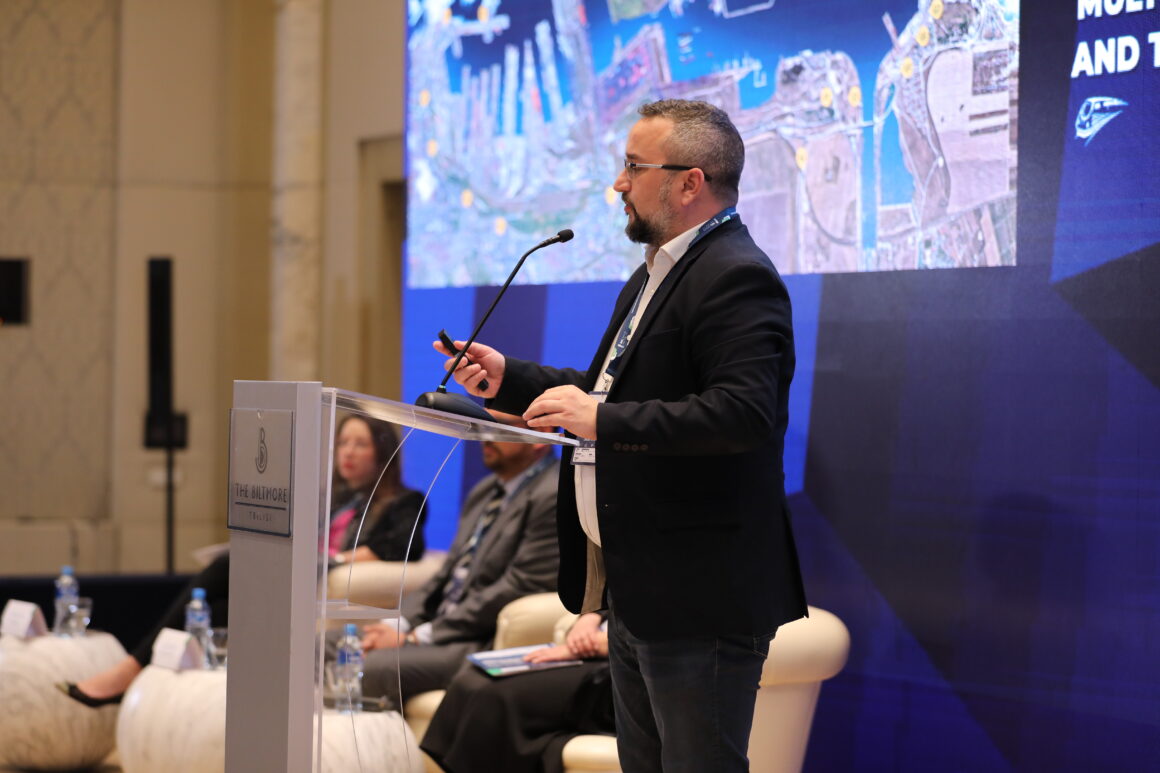
Daniel Jarnea, Head of Marketing at Constanta Port Administration, reviewed the latest developments in the Port of Constanta and its role over the past two years.
As the largest EU port on the Black Sea, the Port of Constanta occupies a strategic position, serving as a vital link between Central and Eastern Europe and various global markets such as Central Asia and the Middle East. Its importance extends beyond Romania, serving as a maritime gateway for landlocked countries in the region.
Covering an area of approximately 4,000 hectares, two-thirds of which is above water, the port boasts a working depth of up to 90 meters, allowing it to accommodate the largest ships sailing the Bosphorus. Its dual nature as a river and sea port facilitates the smooth transshipment of goods, catering to a variety of transportation needs.
With a throughput capacity of over 100 million tonnes and home to 38 port operators and 100 forwarding companies, the Port of Constanta is a bustling hub of activity. Its role as a grain hub linked to the Danube River facilitates agricultural exports from countries such as Romania, Serbia and Hungary, increasing trade volumes.
In addition, the port’s extensive transport links, including road, rail and pipeline networks, ensure efficient distribution of goods both domestically and internationally. Connected to the Black Sea-Danube Canal and located in the Tenty Corridor, the port maximizes accessibility and trade opportunities, making it a cornerstone of regional and global trade.
The Port of Constanta serves as an important hub for the transport of both dry and liquid cargo, enabling efficient river transport of project cargo and offering environmentally friendly fuel transport options. By forming columns of barges downstream, the port can transport significant volumes, reducing dependence on trucks and rail cars.
“In terms of cargo volume, the port has shown steady growth over the past six years, reaching a record level of 92.7 million tons last year. Grain makes up a significant portion of cargo, reaching 36.2 million tons, along with other goods such as oilseeds, partly due to the transit of Ukrainian cargo. However, the port’s scope of activity extends beyond dry bulk cargo, with two container terminals handling a combined volume of 1.4 million TEU.
Despite problems in the past, such as financial restrictions imposed by the EU, the port has regained the pace of container traffic, with volumes constantly growing. Investments in infrastructure, including road and rail connections to the hinterland, further improve the port’s connectivity and capacity, positioning it as a key player in the region’s maritime trade,” said Daniel Jarnea.
The port’s hinterland, largely made up of countries along the Danube River, has expanded to include Ukraine since 2022, despite the ongoing conflict. Last year, the port handled 26 million tons of cargo, of which a significant portion, 50 million tons, was grain, and 5 million tons were oilseeds, mainly imported from Ukraine.
“The port’s destinations span Turkey, North Africa, the Middle East, as well as Spain and France. Recent geopolitical shifts, such as transit restrictions through Russia, have caused a reconfiguration of logistics corridors, increasing the role of the port of Constanta as a critical hub connecting the Baltic, Black and Caspian seas.
In response to developing trade dynamics, the port is embarking on ambitious development projects such as the Rail to Sea corridor, part of the Three Seas Initiative, connecting Constanta with Gdańsk. This initiative, which involves Romania, Hungary, Slovakia and Poland, promises to optimize rail transport and promote economic links between the industrial centers of Central and Eastern Europe, strengthening Constanta’s position as a key gateway for trade between the Black Sea and Northern Europe,” shared Daniel Jarnea.
The Port of Constanta continues to expand its connections with key ports in the Black Sea region, in particular with the Georgian ports of Poti and Batumi. Since 2022, a new communication line has been opened between Constanta and Poti, allowing not only container transport, but also a RoRo line for semi-trailers. The growing operational capacity of the ports of Poti and Batumi is promising, allowing larger ships to handle larger volumes of cargo, thereby stimulating trade along the Black Sea corridor.
The Anaklia project, a proposed port in Georgia, has implications as a potential mirror port for Constanta, expanding the port’s footprint and facilitating trade beyond containers and semi-trailers. The Caspian market opens up opportunities for the transport of raw materials and components, highlighting the importance of having a large port with deep-sea access to accommodate large ships and create a seamless corridor between Constanta and Georgia.
“In addition, an example of the effectiveness of short-sea shipping in the Black Sea is the introduction of a new RoRo line between Constanta and Karasu, Turkey. This direct route significantly reduces transit times compared to previous routes, highlighting the potential for improved connectivity and economic development in the Black Sea region. Overall, these developments represent positive progress for the future of the port and the dynamics of regional trade,” concluded Daniel Jarnea.