

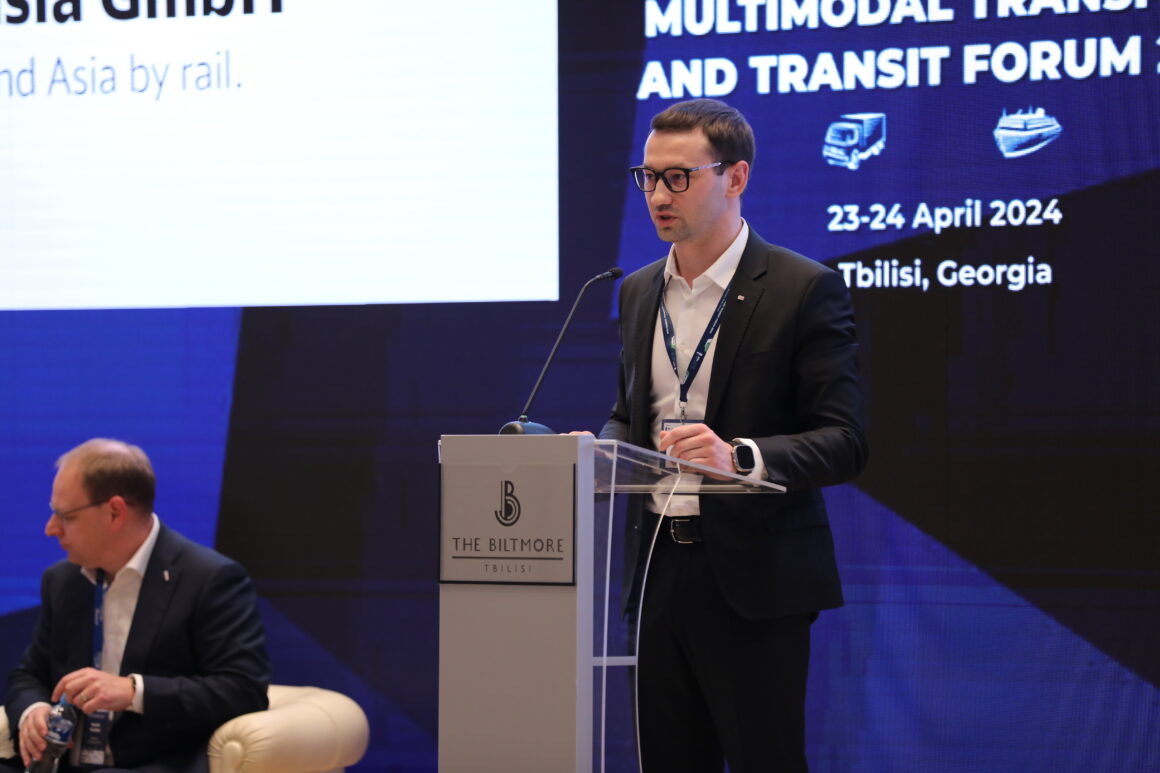
Gleb Shilov, Director of Sales Single Container at DB Cargo Eurasia, noted that the company has been one of the leading road operators in the field of container transportation between Europe, China and Central Asia since 2008. The turning point came in 2011 when they opened the first regular rail route between Chongqing and Duisburg. From 2022 to 2023, the company launched full-fledged trains connecting China and Europe in both directions, with impressive travel times.
“Our services are mainly based on two key offerings: block trains, comprising a minimum of 41 containers, and single container shipments, comprising units or groups of 20ft or 40ft containers. Although our current activities mainly cover the Northern Corridor, we are diligently exploring the possibility of expanding into the Central Corridor, ensuring impeccable quality of service and fast delivery times to market,” said Gleb Shilov.
DB Cargo Eurasia, an integral part of Deutsche Bahn, benefits from full integration into the extensive European terminal network, facilitating the transport of cargo to any destination throughout Europe. Their outstanding features include unprecedented speed, especially evident on express trains, with a realistic transit time of 12 days between Chinese and European terminals, ensuring fast and safe transportation throughout the journey.
The company’s commitment to customer satisfaction extends to 24/7 tracking and tracking, providing real-time visibility into container locations. Moreover, choosing rail transport significantly reduces your environmental impact compared to other modes of transport.
After the speech, there were several questions from the audience: “You said in your presentation that you have not yet used the service through the Middle Corridor. What specifically stopped you from using this route? And how have you so far persuaded clients not to use this route, even in test mode?”
Gleb Shilov responded that convincing customers not to use this route during the testing phase was difficult due to the inability to guarantee fast delivery times. Until they can provide faster transit and improve service, they are holding off on offering the route as an option. However, the company is actively developing this route, working on creating its own service infrastructure in Europe and is looking forward to the opening of Kars.
The second question was: “How does DB Cargo plan to develop this route or help develop this route in the future?”
“At the moment we are actively working on organizing our own service in Europe, and are also waiting for the opening of Kars.
We then have a developed solution that will allow us to provide our customers with the shortest possible transit time along this corridor. Unfortunately, we will not meet the 12 days required for a full-time scheduled train, but I think this time will be much more attractive than what we see now,” concluded Gleb Shilov.