

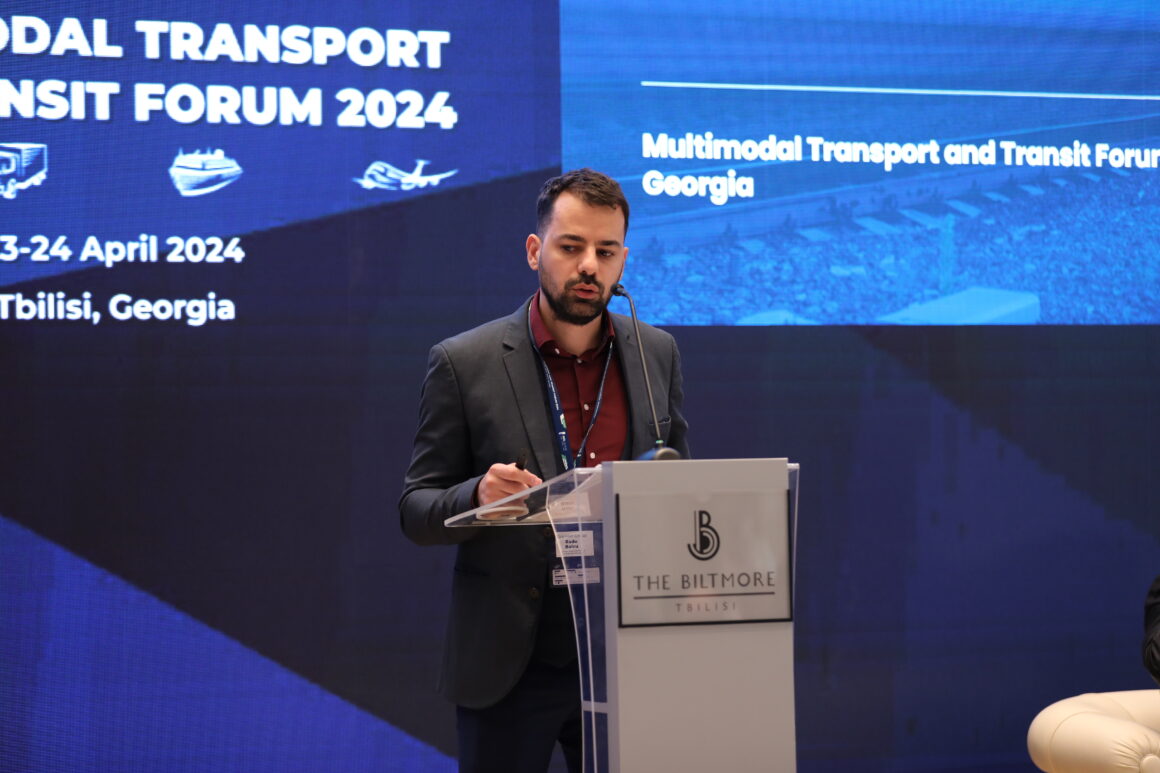
Radu Balcu, Manager of the Business Improvement and New Businesses Department at GRAMPET GROUP, dedicated the presentation to the most important factors necessary to position the Middle Corridor as the main rival to the Northern Corridor. At the forefront of this endeavor is the Grampet Group, a pioneering multinational company headquartered in Romania.
“The basis of our activity is that we own the largest rail freight operator in Romania, which makes a key contribution to the optimization of cargo transit, in particular by facilitating the movement of Ukrainian cargo to Constanta. Our influence extends further through the ownership and operation of four locomotive and railcar manufacturing plants in Romania, which serve as modernization, repair and construction centers. With total revenue exceeding 400 million euros in 2023 alone and a dominant market share exceeding 30% in the Romanian rail freight sector, Grampet Group is an industry titan,” Radu Balcu said about the company.
Their influence is reflected in the entire transport sector: more than 15 million tons of cargo, mainly consisting of oil and petroleum products, are transported annually. Moreover, the company’s market dominance covers more than 75% of the rail freight market in Romania and Bulgaria. With a range of services spanning rail transportation, locomotive and wagon manufacturing, repairs, modernization, leasing and supply chain logistics solutions, Grampet Group remains at the forefront of innovation and efficiency in the railway sector.
In addition, recent events highlight the commitment to the development of regional rail infrastructure, including major tenders for the modernization of locomotives and passenger cars. In addition, innovative investments in transhipment infrastructure support the vision of strengthening the region’s logistics capabilities: plans are currently underway to launch Romania’s largest grain transshipment facility, representing a transformative investment of approximately €10 million.
With growing uncertainty surrounding the Northern Corridor, exacerbated by geopolitical tensions such as Russia’s invasion of Ukraine, the appeal of alternative routes has increased for businesses wary of cargo transiting through Russia. While the World Bank’s endorsement of the Middle Corridor as a promising alternative is encouraging, it also highlights persistent obstacles such as:
- extensive border crossing,
- operational inefficiency,
- long transit times compared to existing routes.
Addressing these challenges requires concerted efforts to digitalize, standardize processes, and increase collaboration among corridor operators. Grampet Group remains steadfast in its commitment to unlocking the full potential of the Middle Corridor, advocating streamlining operations, strengthening critical infrastructure connections and optimizing cargo flows across the Caspian and Black Seas to ensure seamless and efficient logistics.
Recent studies by the World Bank have shed light on the significant potential of the Middle Corridor, with cargo volumes expected to triple by 2030. This corridor is intended not only to serve as a vital regional conduit for countries such as Georgia, Kazakhstan and Azerbaijan, but also as a critical transit route for China and Uzbekistan to access European markets. With expected annual traffic flows of approximately 5 million tons to Kazakhstan, 1 million tons to Georgia and 0.7 million tons to Azerbaijan, the Middle Corridor is becoming a cornerstone of regional trade and connectivity.
presenting its own set of opportunities and challenges. Although routes through Turkey, Bulgaria and Serbia, as well as routes through Georgian ports through Romania and Bulgaria, are relatively accessible, a third route connecting Georgian ports with Romania and Bulgaria faces obstacles, including irregular traffic and increased costs, exacerbated by the geopolitical situation. In order to fully exploit the potential of the corridor, it is necessary to immediately pay attention to solving three main problems,” shared Radu Balcu.
- Firstly, the lack of coordination between operators in China, Kazakhstan, Azerbaijan, Georgia, Romania and Europe leads to the need for a joint venture to harmonize activities.
- Secondly, optimizing the efficiency of the Caspian and Black Sea ports, similar to the current investments in the Romanian port of Constanta, is critical.
- Finally, border crossing and transhipment delays require rapid digitalization initiatives, perhaps through a single application, to improve operational efficiency and reduce delays.
Romania is undertaking an important transport initiative to create a fourth corridor connecting the port of Constanta with Budapest, Vienna and ultimately Germany. The development of this corridor is critical to increasing the speed of freight trains, which currently averages 15 km per hour. To improve the viability of the Middle Corridor, it is important not only to address infrastructure deficiencies, but also to optimize container traffic to reduce transit times through Romania and neighboring countries.
The success of the Middle Corridor depends on the comprehensive solutions outlined in the World Bank report, including establishing daily connections to the ports of Constanta and Varna and providing superior intermodal transport services that will link these ports to Central and Western Europe. This strategic approach not only promises shorter transit times between China and Europe, but also results in lower costs and increased competitiveness, positioning the Middle Corridor as a serious alternative to the Northern Corridor.
Radu Balcu concluded his presentation by talking about how reimagining the Middle Corridor as a key economic artery will lead to a transformational shift in regional trade dynamics, especially in Kazakhstan, Azerbaijan and Georgia. Using this corridor opens up opportunities to strengthen trade ties with the European Union and Turkey, while diversifying trade routes and eliminating dependence on Russia. World Bank forecasts highlight the enormous economic potential of the Middle Corridor, which will be dominated by a variety of commodities by 2030, signaling a promising trajectory for regional economic integration and growth.
The speech was followed by a question from the audience: “Romania has obviously been a very important participant and contributor to the Middle Corridor and its development over the years. Obviously, you saw an increase in volumes when the war in Ukraine began. What is the future strategy of the Romanian government or the Romanian infrastructure, if you know the answer, and how does Romania want to reconcile the investments that Georgia, Azerbaijan and Kazakhstan are actively making right now to develop the route?”
Radu Balcu responded that since the start of the conflict, the Romanian government has directed significant investments into the port of Constanta, focusing on increasing capacity and modernizing the railway infrastructure, in particular to facilitate grain storage. Notably, the port witnessed a major milestone last year, with cargo volumes reaching a record 75 million tonnes, highlighting Romania’s commitment to strengthening maritime infrastructure with European Union funding. Plans are also underway to open intermodal terminals throughout Romania, which will solve connectivity problems and prepare for future integration opportunities, in particular the potential accession of Moldova, Georgia and Ukraine to the EU.
The urgent need to improve intermodal terminal capacity, especially along the border with Ukraine and Moldova, underscores the importance of facilitating seamless connectivity in the region. Discussions surrounding the integration of neighboring countries into the EU offer a promising prospect of eliminating existing bottlenecks related to customs issues, document inconsistencies and delays, signaling Romania’s readiness to expand its logistics capabilities. These developments raise questions regarding the development of intermodal connections between the port of Constanta and other European cities, highlighting the need to remove speed restrictions in Romania’s railway infrastructure to optimize transit times and support intermodal transport. Given the ongoing efforts to prioritize the repair of railway infrastructure and the optimization of freight transit, stakeholders remain hopeful that the upcoming improvements will increase the competitiveness of rail transport compared to road transport, highlighting the importance of joint initiatives between Romania and the EU to realize this vision.
“We have held several meetings in Brussels with some officials to highlight the disadvantages of rail freight transport at present compared to road transport, and only if we balance and make it more competitive between the two modes will customers begin to switch from road transport to railway. In the end, it is also a matter of cost, and the client does not want to pay more for the same service,” concluded Radu Balcu.