

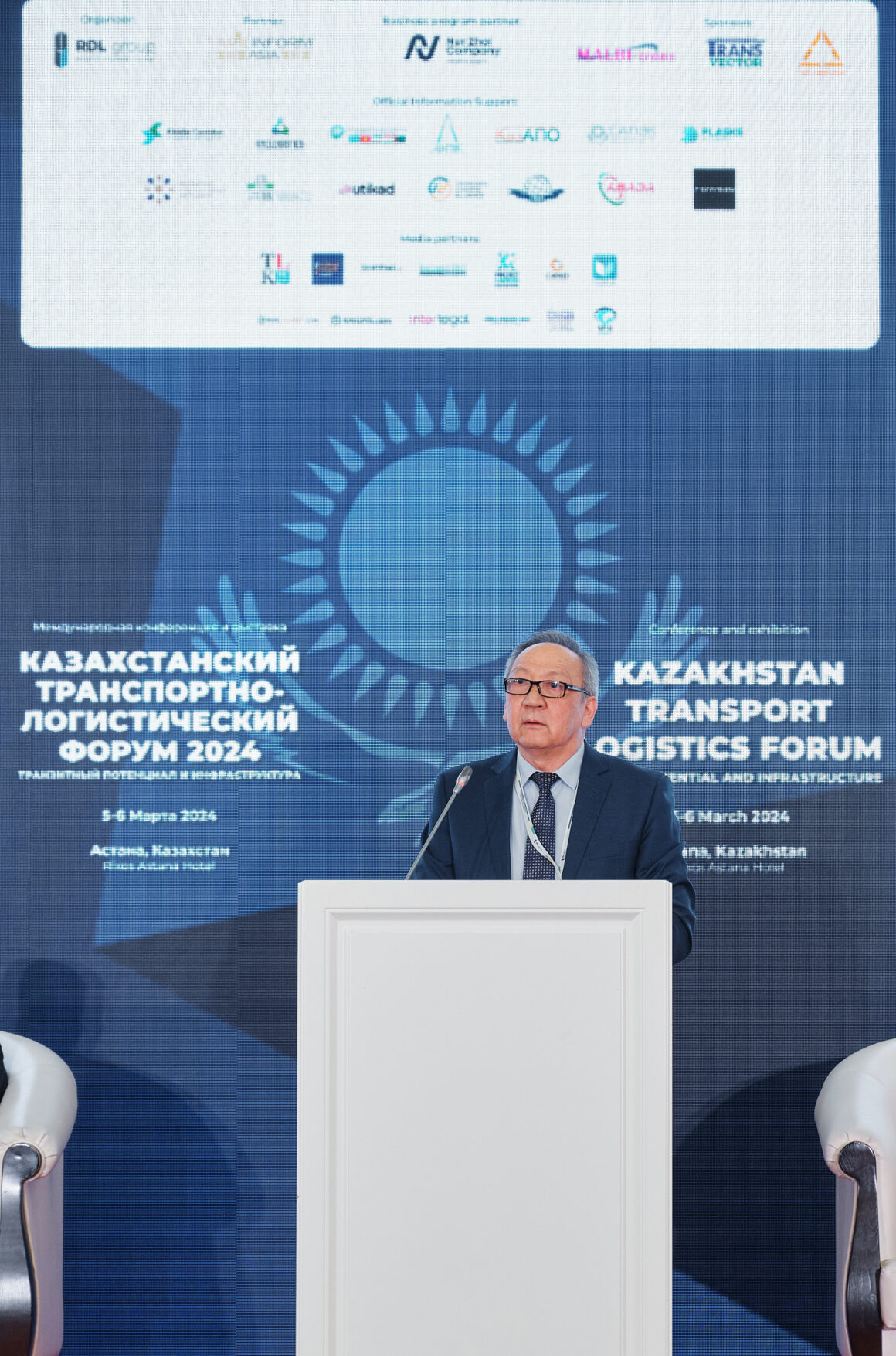
Bulekbaev Berik Raimbekovich, President, Association “Partnership on Transport and
Logistics in Central Asia” dedicated his speech to a priority issue – the development of port areas and border hubs.
“In Kazakhstan we can distinguish two regions: the Ulytau region, presented in the diagram, and the Zhezkazgan transport hub. The Zhezkazgan transport hub, located in the very center of the country, plays a strategic role as a crossroads of various routes: north-south, west-east and internal center. It also provides connectivity to Iran and Uzbekistan. Currently, the development of this region is actively underway, it is planned to open dozens of industrial enterprises, which creates significant potential for a transport hub,” said Berik Raimbekovich.
However, despite its potential, the Zhezkazgan transport hub suffers from underdevelopment. Insufficiently developed infrastructure threatens the region’s capabilities. The station does not meet the requirements, and the volume of traffic through the hub requires a significant increase. The potential for the development of container shipping and the creation of a transport and logistics center in the future is an important prospect.
There is an urgent need for containerization of transport flows in Kazakhstan, where only 3-4% of them are currently covered. Large companies are ready to invest in this process, from repairing containers to producing new containers. In Zhezkazgan, where a project for the construction of highways and the development of an airport is being carried out, there is an opportunity to create a super multimodal transport hub.
“In this context, other regions, such as Semey and Abay region, are also important. The Abay region is located in the center of industrial zones and has the potential to become a key transport hub due to its geographical location, the Irtysh River and the opening of the line to China,” added Berik Raimbekovich.
At the same time, Zhezkazgan and other regions are faced with the problem of an insufficient number of container terminals, which complicates their development. There is a need to invest in infrastructure and development of transport hubs to provide efficient container services and cope with the growing demand for transport.
Berik Raimbekovich also noted that the ports of Aktau and Kuryk face important tasks related to the development of the port area. Although there are already container terminals in Aktau and Kuryk, they operate locally for the port. The congestion of the port emphasizes the need to create a transport and logistics terminal in port areas such as Mangyshlak, Shetpe and Beineu. Such terminals could optimize cargo flows, providing the port with exactly the required number of containers without overloading it.
These terminals could serve not only the ports of Aktau and Kuryk, but also become key points on the North-South route, connecting various regions of Kazakhstan and neighboring countries. In addition, locating terminals near ports would help reduce the risks associated with the instability of the Caspian Sea and diversify the directions of cargo transportation.
In modern competitive conditions, it is important not only to have individual ports, but also to build effective supply chains as a whole. Therefore, for a port, creating a stable connection with logistics centers becomes a key competitive advantage, which is confirmed by global experience in the development of port and logistics infrastructures.
“The advantages of close proximity to seaports are actively used not only for logistics purposes, but also for the location of production facilities, which is an important trend in the development of modern ports. The formation of industrial parks or transport and logistics centers in the port area can reduce transport costs, improve accuracy and delivery times, and also reduce the risk of cargo damage,” added Berik Raimbekovich.
These benefits are well illustrated by the examples of major world ports such as Hamina-Kotka in Finland and Rotterdam. The port area usually occupies a significant part of the port territory and takes on most of the heavy lifting, freeing the port from routine and ensuring more efficient use of its capacity. Similar models of operation of port areas are also used in other large ports, such as Gdansk, where millions of tons of cargo and containers are also actively processed annually.