

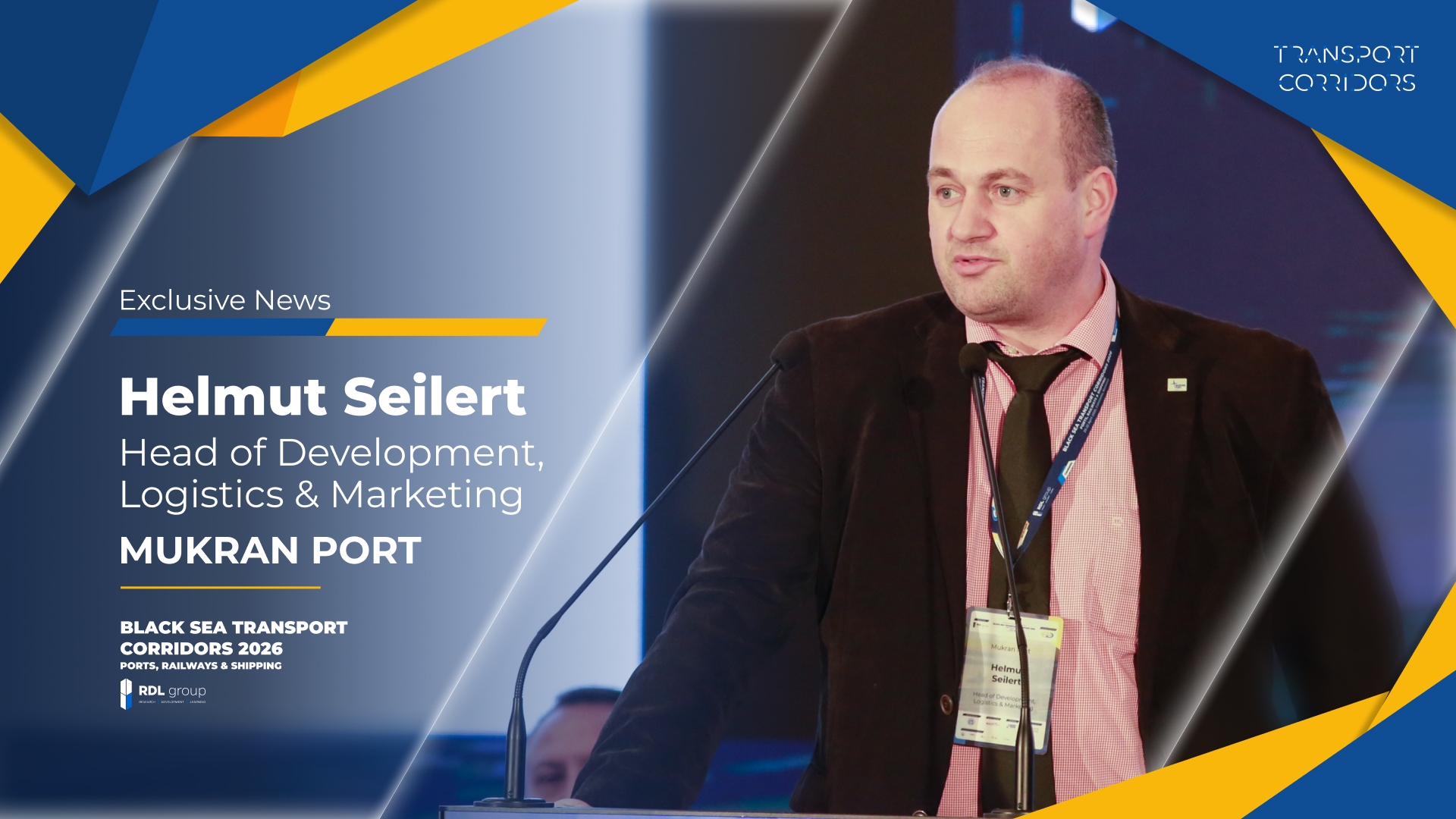
Head of Port Development at Mukran, Helmut Seilert, presented a unique concept of connecting two seas at the BLACK SEA TRANSPORT CORRIDORS 2026: PORTS, RAILWAYS, SHIPPING conference.
The Port of Mukran, described as a “young” European port founded in 1986, serves as the shortest link between the 1520 mm railway gauge network and Germany. A striking technical fact highlighted during the presentation was that the rail-ferry vessels operating in Mukran are almost identical to those used in the Black Sea, creating a natural technological symmetry for building a unified “Black Sea–Baltic Sea” corridor.
Seilert pointed to the example of the Kiel Canal, noting that it saves vessels more than 200 nautical miles and a full day of sailing compared to the route around Denmark, a critical advantage for Eurasian container transport where time is a key factor. He also recalled that before 2022 Mukran handled around 50,000 TEU of Chinese transit annually, receiving up to four container vessels per day.
He stressed that “the pie is big enough for everyone” and that the Middle Corridor will coexist with the Northern route, as the global economy is too interconnected to rely on a single pathway. Mukran is also actively diversifying beyond containers, planning to double grain handling to 2 million tons and expanding offshore wind energy projects. Seilert called for cooperation with Constanța, viewing the Black Sea-Baltic link as a gateway to Scandinavian markets, adding:
“The pie is enough for all. Under normal conditions, the Middle Corridor will remain in demand. We offer a door to Scandinavia for cargo coming from the Black Sea. It is pure geometry, no magic.”
For more interviews and news from the world of logistics, visit TransportCorridors.com
You can also take part in international logistics events organized by RDL group – visit the website for more details.