

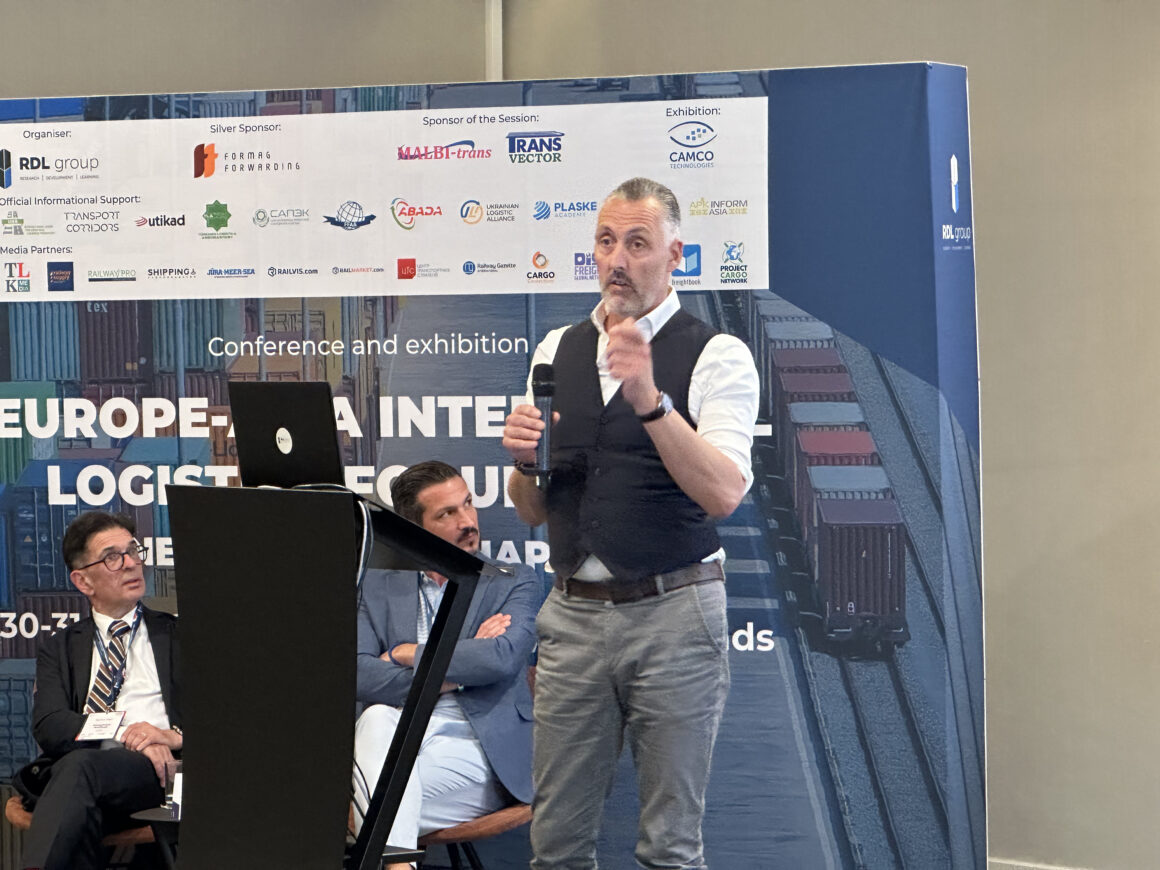
Mark Jansen, CEO of Hupac NV, began his speech by introducing his company. Hupac NV, covering 130 intermodal trains daily, operates traditional “Red Line” intermodal routes tailored to the needs of road transport, as well as “Blue Line” maritime routes operated by their subsidiary ERS, with a focus on key ports such as Bremerhaven, Hamburg and Rotterdam. Despite challenges such as the economic downturn and infrastructure failures such as the closure of the Gotthard Base Tunnel, HUPAC remains resilient.
Their core business is diversified: 30% in chemical products and 70% in general cargo, balancing between short- and deep-sea logistics. The intermodal segment, their fastest growing rail division, benefits from strong port and terminal infrastructure strategically located near economic centers.
In the face of competition from the automotive industry, HUPAC emphasizes flexibility and customized design solutions, ensuring that they meet the diverse needs of customers while maintaining high standards of service. Their approach highlights a deep understanding of market dynamics and a commitment to leveraging their extensive network for sustainable growth and operational excellence in European logistics.
“We highlight the strategic importance of owning assets such as wagons and terminals to increase network density and operational flexibility in the logistics sector. We are planning significant investments, including the future Duisburg DGT terminal, which is scheduled to be completed by 2025 as a key tri-modal hub. With a significant €500 million portfolio dedicated to terminals and infrastructure, we highlight the urgent need for significant investment in TEN-T corridors to improve train productivity and efficiency,” said Mark Jansen.
Addressing infrastructure challenges, HUPAC advocates for streamlining processes and improving last-mile rail service to minimize travel times and maximize efficiency. They highlight the need to improve transparency and speed up operations at ports and terminals, which is critical to optimizing logistics flows across their vast network.
The company faces various operational challenges, including infrastructure work impacting schedules and unexpected delays. They advocate for gauge harmonization between European and Chinese railways to improve capacity utilization and facilitate the movement of heavier and longer trains at shorter intervals, which is crucial for increasing capacity in both passenger and freight networks.
HUPAC operates key routes connecting Rotterdam, Duisburg, Lutushaven and Vienna, and plans to increase frequencies and expand services to Poland and beyond. They highlight the effectiveness of the tiered system in optimizing freight flows, especially through Turkey, Romania, Bulgaria, Serbia and Italy, centered around the Vienna hub.
Looking to the future, HUPAC aims to boost maritime connectivity with Northern and Central Europe, highlighting their proactive approach to integrating different modes of transport and optimizing logistics networks. Their strategic initiatives focus on streamlining operations, reducing delays and improving service reliability.
With a presence in Shanghai and dedicated teams for China-Europe logistics, HUPAC uses numerous platforms and logistics centers in Rotterdam, Antwerp, Hamburg and soon Duisburg and Barcelona to strengthen its Europe-China-Europe connections. Despite challenges such as subsidy cuts and restrictions on certain products, the company remains steadfast in connecting economic hubs through integrated tri-modal solutions, providing competitive transit times and efficient freight management.