

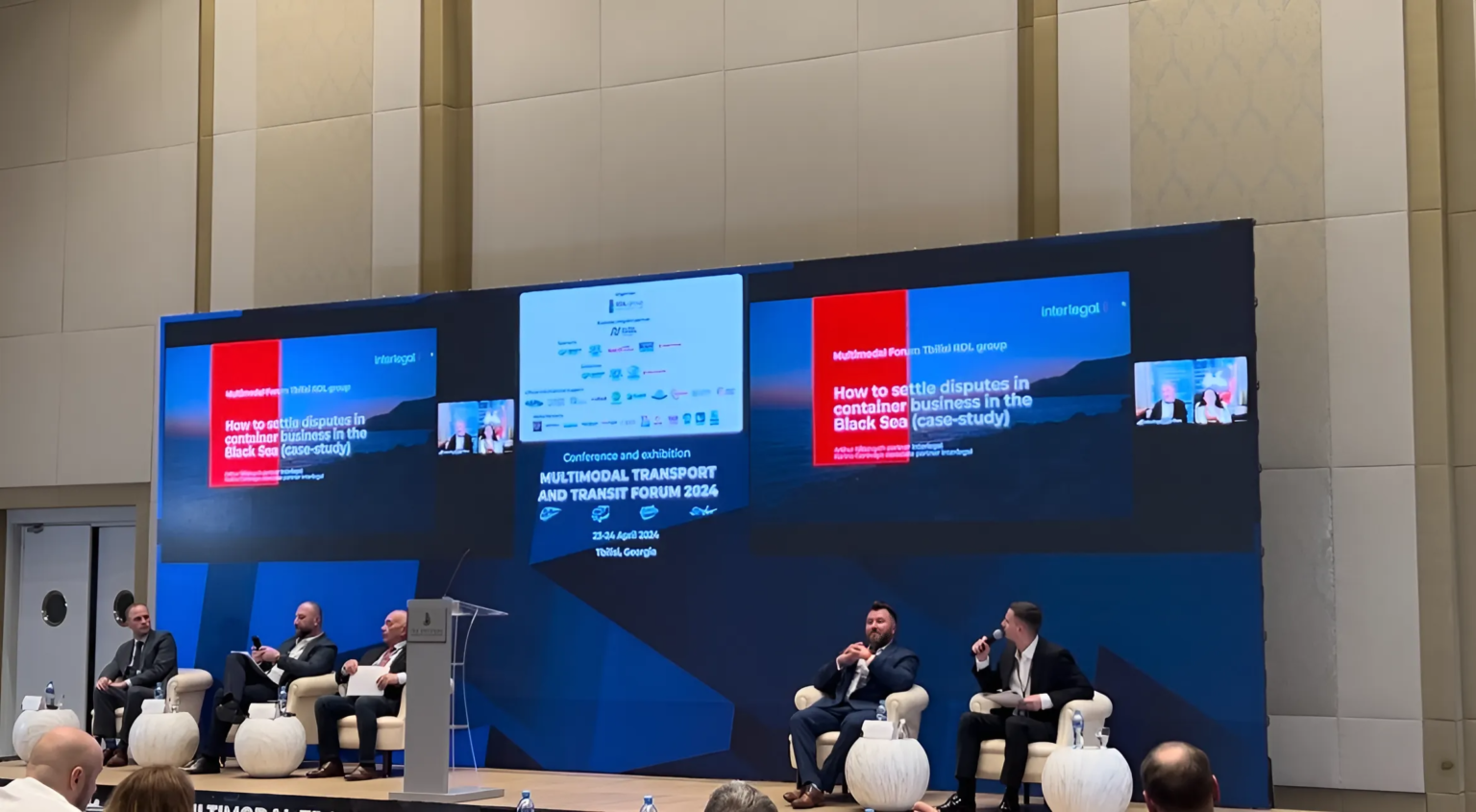
Arthur Nitsevych, Partner at the law firm Interlegal, spoke to the audience virtually along with his colleague Karyna Gorovaya, Associate Partner of the company. Although the guys were unable to meet in person this time, they expressed hope for a live meeting next year.
With nearly three decades of experience, Interlegal specializes in maritime and transport law, with offices strategically located throughout the Black Sea region and recently opening its headquarters in Cyprus. Arthur highlighted Cyprus’ membership of the European Union, which brings the firm closer to Europe, and noted the jurisdiction’s compliance with English law, which is critical in regulating charters and bills of lading in the maritime industry. In addition, he highlighted Interlegal’s extensive network of correspondents in key trading countries, which facilitates the rapid resolution of transportation-related claims such as non-payment of freight or cargo quality disputes.
Recent developments in the Ukrainian container market were discussed at a round table in Kyiv, shedding light on the transformation of the sector against the backdrop of geopolitical shifts. Prior to Russian aggression, the region was identified as a high-risk area by the Joint Warfare Committee in London, which led to significant changes in Black Sea shipping dynamics. Despite maintaining overall throughput at 3.5 million TEU, maritime container traffic has fallen sharply, with only about 70,000 TEU passing through Ukrainian ports last year, down from a pre-war level of 1 million TEU.
Although the cargo base, especially for grains and oilseeds, remains stable for export, most cargo now moves along alternative routes by road or rail to European ports such as Poland, Romania and Constanta. Ukrainian container market players have expressed concern about a lack of port calls, which is reducing the incentive for larger container ships to move around the Black Sea region, mirroring a trend seen with cruise ships bypassing the area. However, recent positive signs have emerged with the arrival of the Timare, the first container ship to dock at the port of Chernomorsk since April under the Panamanian flag, signaling a potential revival of container traffic through the seaports. From Ukraine’s perspective, cooperation between authorities, shipping lines and freight forwarders is critical to restoring volumes and improving the outlook for multimodal transport, despite remaining challenges such as war risk insurance issues.
“Discussions have resumed about container transport by barge on the Danube River, with the Ukrainian Danube Shipping Company playing a key role in providing this service. In addition, there has been renewed interest in the Silk Road transit route: the port of Chernomorsk is sometimes considered on maps to be part of this route. It is noteworthy that the container terminal in the port of Chernomorsk is preparing to be transferred to concession this year, and anticipation for the upcoming tender announcement in the summer is growing, attracting the attention of international investors who want to take part in it,” shared Arthur Nitsevych.
Positive changes are expected in this regard. For those interested in interacting with the Ukrainian Freight Forwarders Association, opportunities abound as Interlegal is ready to facilitate connections. Next, Karyna Gorovaya took the floor, telling a case study of a typical lawsuit scenario, common in the countries of the Black Sea region, shedding light on common problems and litigation in the region.
As vessel calls to Ukraine were abruptly stopped, this led to significant delays in cargo at Ukrainian ports, putting cargo owners and their appointed freight forwarders in a difficult position. Among these issues, a notable case arose involving a freight forwarding company engaged by a Chinese buyer, tasked with facilitating the transport of goods from Belarus through Ukraine to China.
As containerized cargo accumulated at the Ukrainian port due to the disruption of vessel calls, the land carrier quickly sought compensation for the damage, demanding compensation from the freight forwarder for storage and damage. In response, Interlegal began a thorough review of the contractual agreements governing the transaction to determine the legal responsibilities and obligations of the parties involved. Despite acknowledging the freight forwarder’s obligation to pay damages, Interlegal’s review found that payment was contingent on the freight forwarder’s fault, particularly in facilitating the release and return of empty containers to the ground carrier.
In addition, Interlegal’s review revealed important contract provisions stipulating that if the cargo cannot be safely delivered to the port of destination, the responsibility for proper storage and associated costs falls on the freight forwarder. However, a significant caveat emphasizes the reasonableness of such costs, emphasizing the need for a fair trial. Central to the legal discourse surrounding this case was the question of whether the freight forwarder was at fault in this scenario, thereby shaping the trajectory of the litigation and highlighting the nuanced complexities inherent in post-invasion container shipping problems.
“After a thorough analysis, we came to the conclusion that the forwarder faced insurmountable obstacles in processing this cargo. The certificate accompanying the goods lists Ukraine as the only transit country, leaving no room for changing the route through any other European country. The situation was further complicated by the fact that the forwarder had no connection with the exporter, a Belarusian company whose products were subject to sanctions. Consequently, re-certification to facilitate alternative transport was out of the question, leaving the cargo stranded.
Given these circumstances, it became obvious that the forwarder was not responsible for the current situation. Moreover, the possibilities for storing cargo were limited, since it was impossible to transfer it to a customs warehouse or any other facility at that time. The expiration of the freshness of the cargo, especially taking into account the fact that it is fresh meat, made storage impractical and charging for storage unjustified,” Karyna Gorovaya explained the details of working with the case.
And, although the forwarder had legal grounds for declaring force majeure, certain criteria had to be met in order to certify and apply it. Despite the complexity of the situation, legal opinions tended to treat the damage as a penalty, offering the freight forwarder the opportunity to negotiate its obligations. Ultimately, through mediation and legal advice, an agreement was reached whereby the freight forwarder paid part of the storage fees, releasing itself from liability for damages. The cargo currently remains in Ukraine and is subject to processing, symbolizing the complex challenges facing modern logistics.