

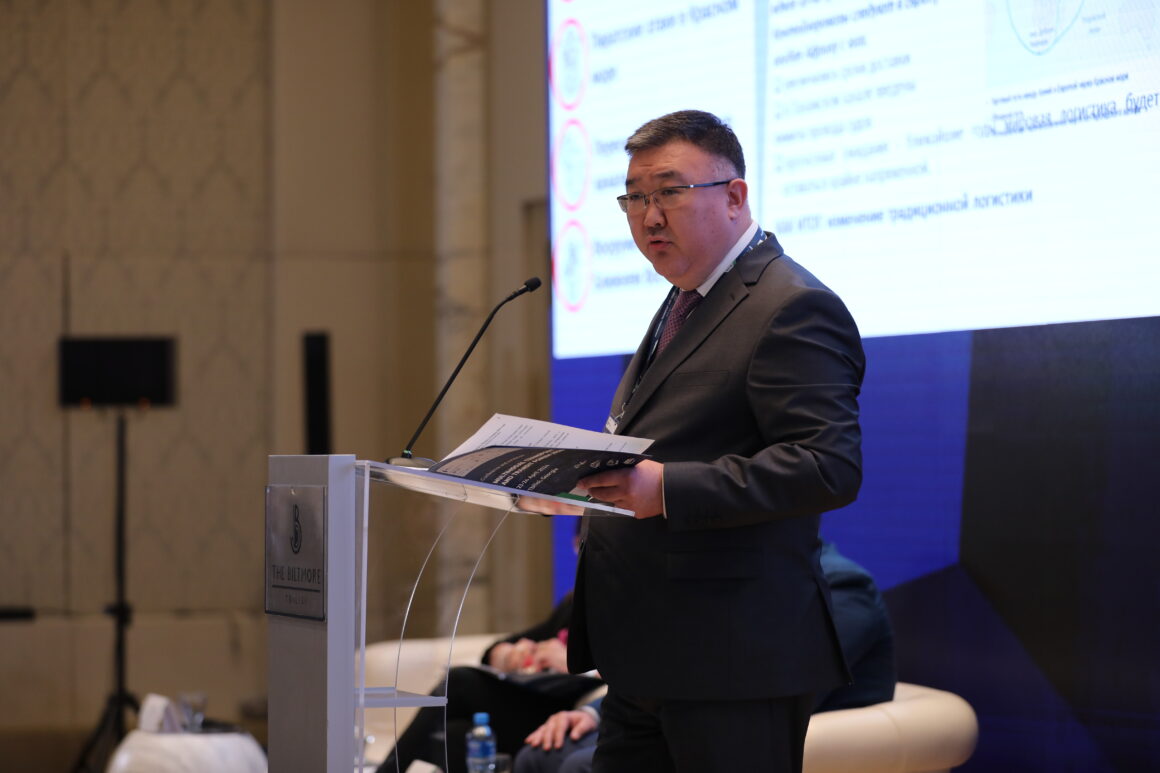
Kanat Kobesov, Chairman of the Supervisory Board of the NurZhol Company, Chairman of the Board of Directors of the National Association of Exporters KazGrain, began his speech by noting that in the modern world, transport corridors are becoming a focus of attention in the context of geopolitical changes and trends. Particularly noteworthy are the corridors of the Caucasus, Central Asia and China, which are now at the peak of popularity. A notable example of this trend is the launch of multimodal cargo transportation between China and Tajikistan through Kulob station in November 2022. As part of this transportation, cargo is delivered through Uzbekistan, Turkmenistan, Turkey and Iran to its destination. This initiates not only the development of the trans-Afghan railway, but also ensures access for Kazakh and Uzbek cargo to Iranian ports on the Indian Sea.
However, despite growth prospects, there are a number of challenges, including differences in the level of development between countries in the region and a lack of synchronization in their actions. This can lead to unbalanced development and lagging behind individual countries.
“Therefore, it is important to make joint, agreed decisions between our countries,” said Kanat Kobesov.
One of the key development focuses in this context is infrastructure. In total, 250 projects were launched in 2020 with a total cost of almost $250 billion, demonstrating the enormous potential for modernizing and expanding transport infrastructure in the region. The development of this infrastructure is predicted to be one of the key factors driving economic growth in the coming decades.
Moreover, trade and logistics are believed to be the engines of economic development in the region. The LPI, which measures the quality of logistics infrastructure and services, is forecast to continue to improve, which will boost trade and attract investment. At the same time, the states of the region are actively carrying out reforms in the railway industry aimed at increasing efficiency and attracting private investment, which creates a favorable environment for the development of multimodal transportation and freight transit routes.
“Kazakhstan is actively working on the development of transport infrastructure, which is of interest to many countries. As part of government initiatives, four major projects are being implemented that will ensure significant progress in the transport sector. In particular, second tracks are being built at sections of the exit from China, such as Dostyk – Moyynty and a bypass transit line bypassing Almaty, which will relieve congestion at the Almaty junction. These projects will increase capacity and ensure effective border transit with Uzbekistan and China,” said the head of NurZholCompany.
The implementation of these projects will lead to an increase in transportation by 70 million tons of cargo, which will significantly increase the current volume of transportation in the country. Industrial development plans will also contribute to further growth in freight traffic. The Government of Kazakhstan has already approved a roadmap, within which it is planned to commission about 1,100 new enterprises by 2030, which will provide an additional increase in cargo transportation volumes by 80 million tons.
The increase in freight traffic is expected to come from transit and exports, with a significant share of cargo heading to Central Asia, the Caucasus and Europe. The main focus of investment in the region will be on infrastructure development, which is supported by both national and international investors. China, as a major trading player, is also actively investing in the construction of new transport routes and transshipment points.
It is important to understand that infrastructure development must be accompanied by progress. Forums and exhibitions are actively held around the world where innovative developments are demonstrated. Over the past twenty years, science has returned to the forefront and concepts such as artificial intelligence and emerging technologies have become in demand. It is necessary to restore and develop scientific activity in order to create a competitive environment.
“The construction of high-tech infrastructure, including railways, transport centers, container terminals and ports, will take all industries to a new level. The use of modern digital technologies in transportation management, digitalization of document flow and the development of e-commerce have already led to significant changes in the logistics world.
Thanks to digitalization and the use of new technologies, transportation processes become more efficient and manageable. The opening of new routes and a variety of transport modes, such as air, road and rail, provide flexibility and scalability in logistics. Promoting multimodal companies and strengthening global integration processes contribute to the development of global trade and exchange of goods between countries,” shared Kanat Kerimovich.
NurZholCompany actively explores non-standard solutions in logistics, including project logistics. One of the key aspects of their long-term plans is to connect the East-West and North-South corridors, which will not only allow them to compete, but also create healthy cases and services.
The second important area is the development of gas transportation infrastructure oriented to the East, including the creation of hubs in Turkey and Iran. We are also actively working on the infrastructure of food production and logistics, given the significant potential of Eurasian countries in this area. This process is also associated with the urbanization of Central Asia, where demand for services, goods and work is expected to grow significantly.
“An important element of our development is also the acceleration of digital transformation, including the introduction of digital components and the expansion of cargo flows with China. We also see potential for cooperation with China in the field of electricity and expect that water, energy and regulatory issues will be raised within the framework of this cooperation,” concluded Kanat Kobesov.