

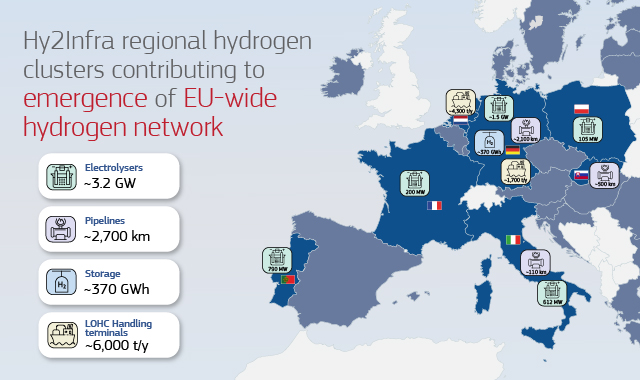
The European Commission has granted approval for state aid amounting to €6.9 billion from seven member states to support the third Important Project of Common European Interest (IPCEI) in the hydrogen value chain. The IPCEI, named “Hy2Infra,” aims to enhance renewable hydrogen supply, reducing reliance on natural gas and aligning with the goals of the European Green Deal and the REPowerEU Plan. The project involves the collaboration of France, Germany, Italy, the Netherlands, Poland, Portugal, and Slovakia.
Under the IPCEI Hy2Infra, the member states will provide €6.9 billion in public funding, expected to leverage €5.4 billion in private investments. Thirty-two companies, including small and medium-sized enterprises, will engage in 33 projects, covering various aspects of the hydrogen value chain. The initiatives include deploying 3.2 GW of large-scale electrolysers, constructing hydrogen transmission pipelines spanning 2,700 km, developing hydrogen storage facilities, and establishing handling terminals for liquid organic hydrogen carriers.
The IPCEI aims to promote interoperability and common standards, facilitating future market integration and supporting the emergence of a European hydrogen infrastructure. Key milestones for the projects include operational large-scale electrolysers between 2026 and 2028 and pipelines between 2027 and 2029, with an overall completion target for 2029.
IPCEI Hy2Infra complements previous IPCEIs focusing on hydrogen technologies for end-users (Hy2Tech) and industrial applications (Hy2Use). The European Commission, evaluating the project under state aid rules, emphasized its contribution to common objectives and the ambitious nature of the infrastructure developments. The IPCEI also involves a claw-back mechanism, ensuring that aid is limited to what is necessary and proportionate.
The project’s financial risks necessitate public support, and participating companies will share acquired knowledge through publications and conferences, fostering positive spill-over effects throughout Europe. Thirty-three projects by 32 companies, including SMEs, will involve collaborations with external partners such as transmission system operators, universities, and research organizations across Europe.
Several Member States, including France, Germany, Poland, and Portugal, have integrated their participation in IPCEI Hy2Infra into their Recovery and Resilience Plans, allowing partial funding through the Recovery and Resilience Facility. Further details on individual aid amounts will be disclosed in the public version of the Commission’s decision, following agreement with Member States and third parties on confidential business secrets.