

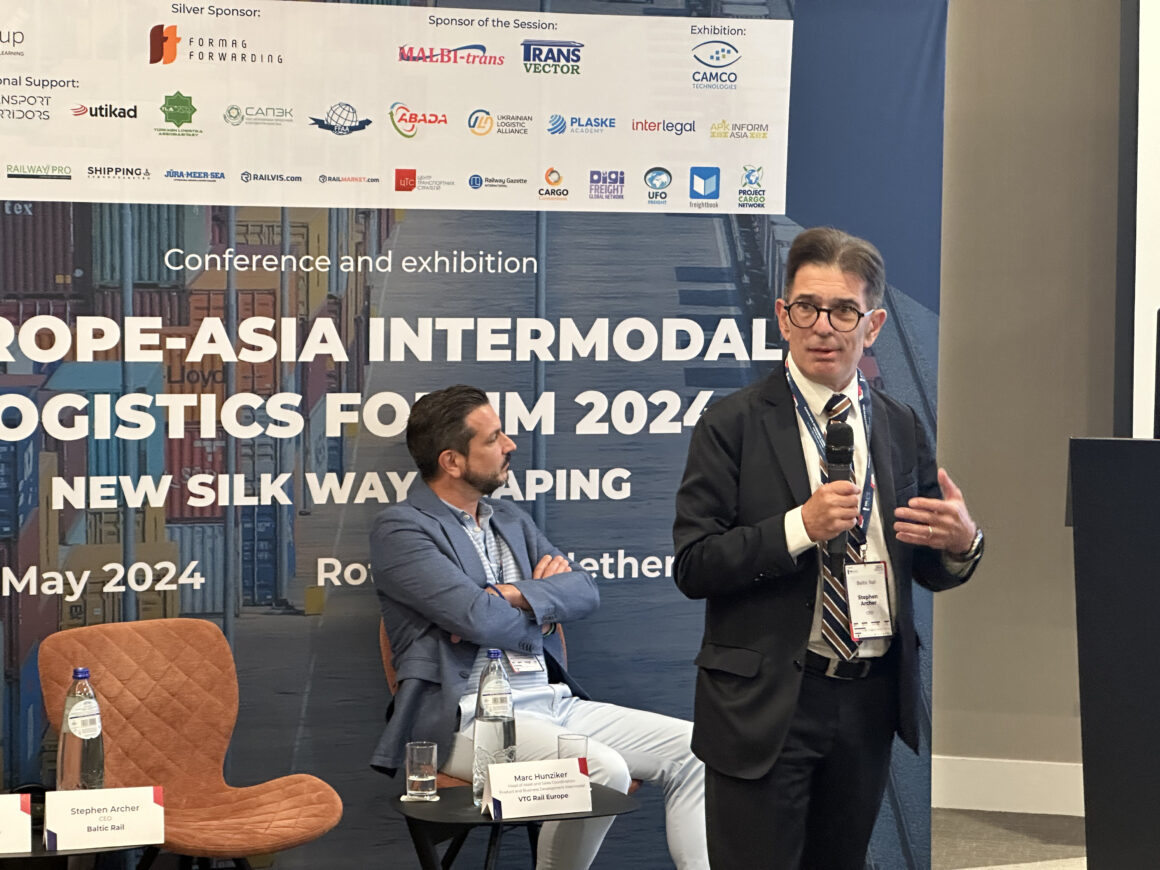
Stephen Archer, CEO of Baltic Rail, said that after the COVID-19 pandemic, the world has experienced significant changes. First there was the conflict in Ukraine, followed by large-scale political movements on environmental issues aimed at creating a greener supply chain. Now we are faced with a crisis in the Red Sea. It’s also worth noting that artificial intelligence has become an important part of our lives, and many of us are still just beginning to adapt to these changes.
Baltic Rail is a small niche player in the field of intermodal rail transport. Founded in 2008, the company remains market neutral and cooperates with any willing shipping lines and forwarders. Although they rarely work directly with shippers, they are always open to dialogue and finding solutions to facilitate efficient operations. The company’s independence is supported by its own locomotives, wagons and licenses, which allows free movement throughout Poland and cooperation with railway companies outside its borders.
“To ensure complete independence, we built our own terminals in Wroclaw and Katowice. In Poland we operate 50 locomotives, and our pride is the locomotive assembled at our factories, using a chassis from former Ukrainian railways, adapted for work in Europe. This locomotive has been upgraded from diesel to electric in our workshops, demonstrating our commitment to innovation and change.
Our history is full of complex projects and successful transformations. The head of the company tasked me with creating an intermodal network, and we focused on the most important regions for this. We have avoided highly competitive markets such as Germany and instead sought unique ways to grow and develop, allowing us to achieve significant success in an ever-changing world,” said Stephen Archer.
Baltic Rail is focused on developing services in the Baltic-Adriatic corridor, with a particular focus on the Polish economy. Poland, originally a large manufacturing economy, has become a major consumer over the past 15 years. Baltic Rail transports both export and import goods, delivering them to the central regions of Poland, which are far from the sea and where rail transport is particularly competitive. Their main traffic comes from Asia – Japan, Korea, China – through the Suez Canal to the ports of Koper, Rijeka and Trieste, and then to Central Europe. This allows cargo to be delivered from China to Moscow in 25-26 days, which is optimal compared to other routes.
Growing the business over the last decade has been challenging but successful. The company has increased the number of services and improved their quality, serving up to four trains per week, which reduces the waiting time for containers in Adriatic ports to one day before being sent to Poland. However, the recent crisis in the Red Sea has had a negative impact on their success. Despite this, Baltic Rail continues to serve north-south, transporting Scandinavian goods to the south and Polish goods to North Africa, the Persian Gulf and the Mediterranean.
Baltic Rail is actively adapting to changing conditions in the field of logistics and intermodal transport. Although existing routes through Lauschwitz were previously congested, they are now functioning much better, which many say has improved supply chains. Difficulties continue on the corridors that previously passed through Ukraine to Hungary, forcing the search for workarounds. For example, cargo movement on the north-south axis now requires a detour through Hungary, whereas previously this was done directly through Ukraine.
“We see an increase in traffic along the middle routes passing through the Black Sea and further through Kazakhstan. In this context, we recently opened a new terminal in Hungary, south of Budapest, together with our green partners. It reminds me of my early years, when moving from rail to intermodal, I followed the auto industry as it pioneered new corridors. Our first customers were General Motors and Toyota, and now we are seeing a new sector – the production of electric batteries – taking us to Hungary,” said Stephen Archer.
The opening of the new terminal in Hungary is linked to the development of the electric battery industry, which creates new transport corridors between Poland, Hungary and China via the Adriatic route. The sector is emerging as a key driver of intermodal transport, highlighting the importance of adapting to new demand for electric batteries in the automotive industry. Baltic Rail is also introducing innovations in the form of electrically powered containers for transporting temperature-sensitive cargo, which allows batteries to be transported efficiently without overheating.