

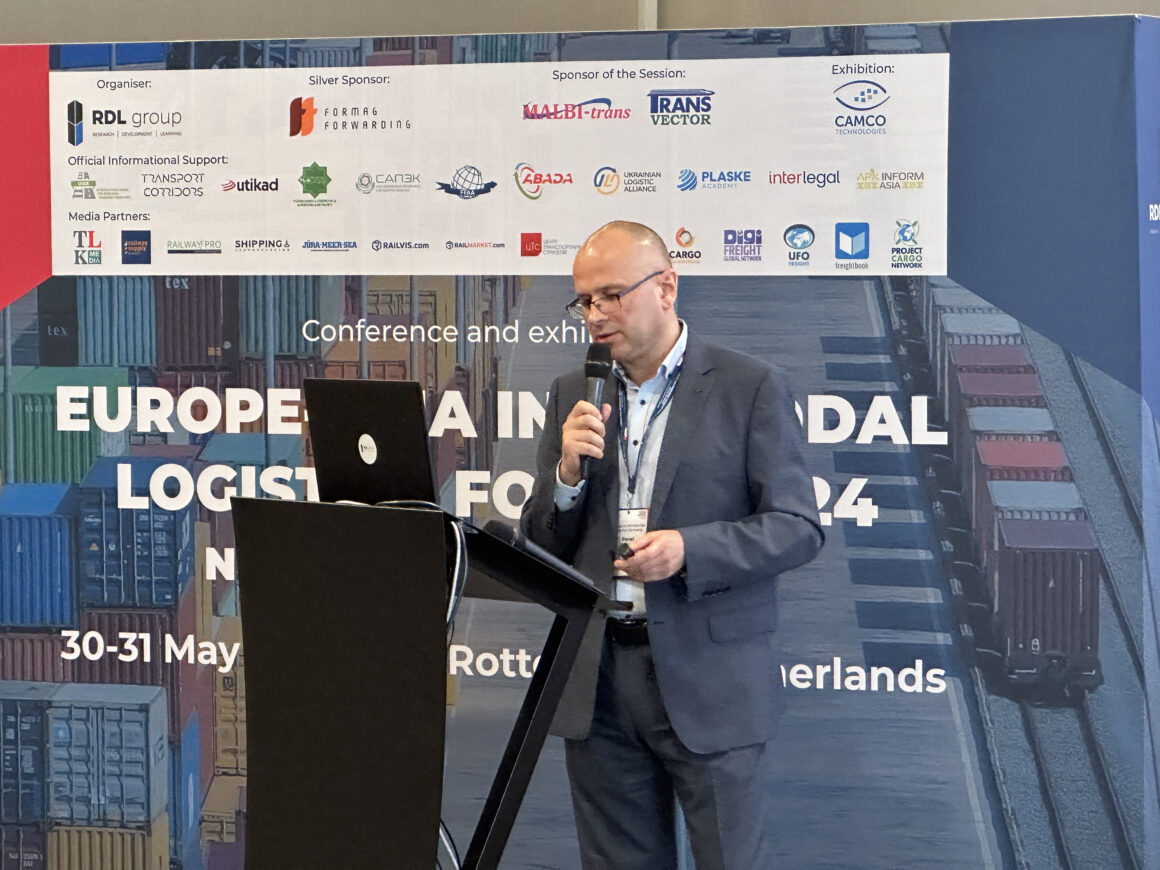
Pavel Lagov, Director of Product Management (CIS), Rail Solutions International, Hellmann Worldwide Logistics Germany, shared that the company’s initial attempts to use the Middle Corridor were not very successful. They were trying to transport cargo from China to Europe for one of the world’s largest OEM suppliers, but their expectations for transit time and financial results were significantly lower than realistic. Many companies that have tried this route have encountered serious problems. The main reasons were bottlenecks and insufficient infrastructure in key locations such as Baku and Aktau, which seriously complicated logistics.
Despite these difficulties, Hellmann continued to work, collaborating with railway companies in Kazakhstan, Azerbaijan and Georgia to improve the situation. Personal involvement and connections helped them advance, but due to the sharp increase in cargo volumes and insufficiently developed infrastructure, efficiency remained low. Experience in 2016-2017 with rail transport from China to Europe via Kazakhstan, Russia and Belarus showed that the successful implementation of such projects requires the coordination of many operators and companies.
However, thanks to the persistence and professionalism of their partners, Hellmann were able to organize cargo transportation. In 2017, with the support of Czech Railways, they managed to deliver a train from the Chinese city of Wuhan to the Czech Republic in 30 days, a significant achievement despite the high costs. This experience helped to realize the importance of cooperation and infrastructure development for successful operation on new routes.
A few years later, the so-called United Transport and Logistics Company (UTLC) was created. This company was founded by three railway companies: Kazakhstan, Russia and Belarus. Since its inception, routes from the Chinese border to the European Union have become a daily reality. Now this huge route is no longer perceived as an unpredictable “black hole” – everything runs smoothly thanks to the professionalism of UTLC, which has optimized business processes and set high standards for customer service.
For the Middle Corridor, westward transit times range from 35 to 45 days depending on the proposed solution. While 35 days is an optimistic estimate for truck use from Baku to Europe, 45 days is more realistic. In the last two years, countries along the Middle Corridor, including Kazakhstan, Azerbaijan and Georgia, have realized the huge potential of this route and have invested heavily in improving infrastructure and business processes. Hellmann currently receives significant support from Chinese railways and logistics platforms in Xi’an, Chongqing and Chengdu.
Most of the journey from China to the port of Baku is covered in 15-17 days, and the process goes smoothly. However, difficulties may arise after this, although everyone involved is working to resolve them. Hellmann have developed various solutions for their customers, including express delivery, intermodal delivery and delivery via Istanbul.
As a logistics service provider, Hellmann is committed to offering reliable, predictable, transparent and cost-effective solutions to its customers. The middle corridor is an excellent alternative to the route through Russia. However, for its effective functioning, a single operator is needed, similar to UTLC on the northern route. Two years ago, railway companies from Kazakhstan, Azerbaijan and Georgia agreed to create a joint venture to optimize this route, but the company has not yet started operations.
“The middle corridor has excellent prospects if these difficulties can be overcome. A few months ago I visited Baku and was amazed by the investment made in the port of Alat. This is a completely new port, which, of course, cannot be compared with Dubai or Djibouti, but compared to what it was before, the port is simply fantastic. One of the bottlenecks has been eliminated. Now, according to some acquaintances, the next bottleneck is Poti.
Two years ago, Poti was a real nightmare when we carried out one eastern shipment: out of four containers, two went smoothly, and two were stuck for two months. We had to unload them and send 20 tons of cargo by plane to China. What is still needed, in my opinion, is a unified and transparent tariff policy, long-term and predictable. Without this, the Middle Corridor will remain unpredictable: some trains will go smoothly, some will get stuck, and no one will be able to say exactly what is happening,” noted Pavel Lagov.
If at least uniform tariffs are implemented and bottlenecks are eliminated, it will be possible to wait for the creation of a single operator. Not too long, but you can wait. Without this, everything will remain at the level of chance, when no one will be able to predict what will happen to the train. At the moment, the situation has improved significantly compared to what it was two or three years ago. The Middle Corridor has a bright future, but more effort, infrastructure investment, and organizational support are required.