

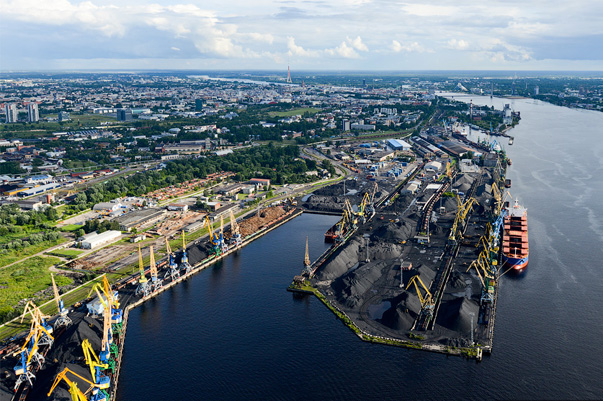
By the end of 2025, cargo turnover at Latvia’s three largest ports – Riga, Ventspils, and Liepaja – was 32.15 million tonnes, according to data published by the country’s Ministry of Economy. The port of Riga remained the largest with a volume of 16.75 million tonnes, followed by Ventspils with 8.53 million tonnes and Liepaja with 6.87 million tonnes. Latvian Minister of Economy Viktors Valainis emphasized that the transshipment of over 32 million tonnes of cargo confirms the port industry’s significant role in the country’s economy and foreign trade.
Cargo turnover at the port of Riga decreased by 7.3% compared to the previous year, or 1.3 million tonnes. The main decline was attributed to timber and agricultural cargo due to unfavorable weather conditions. However, timber cargo remained the largest group, with 5.26 million tonnes, accounting for 31% of the total volume. Container traffic reached 4.97 million tonnes and 495,700 TEU (30% of turnover). At the same time, the port significantly increased its liquid bulk cargo handling by 65% to 1.37 million tonnes. After a two-year hiatus, the volume of petroleum products exceeded 1 million tonnes, while LNG transshipment increased 3.3-fold to 0.22 million tonnes, setting a record in the port’s history.
In 2025, Ventspils increased its cargo turnover by 3.6%, with petroleum products accounting for almost half of this volume – 4 million tonnes (+12%). Cargo transported by car carriers accounted for a significant share – 1.7 million tonnes, or 20% of turnover, while coal transshipment increased by 47% to 1.3 million tonnes. The port’s passenger traffic increased by 4.5% to 270,300. At the Port of Liepaja, on the other hand, cargo turnover decreased by 2.53% to 6.87 million tonnes: more than half of this volume consisted of local cargo, while bulk cargo, primarily grain, accounted for the majority of the cargo – 4.55 million tonnes.