

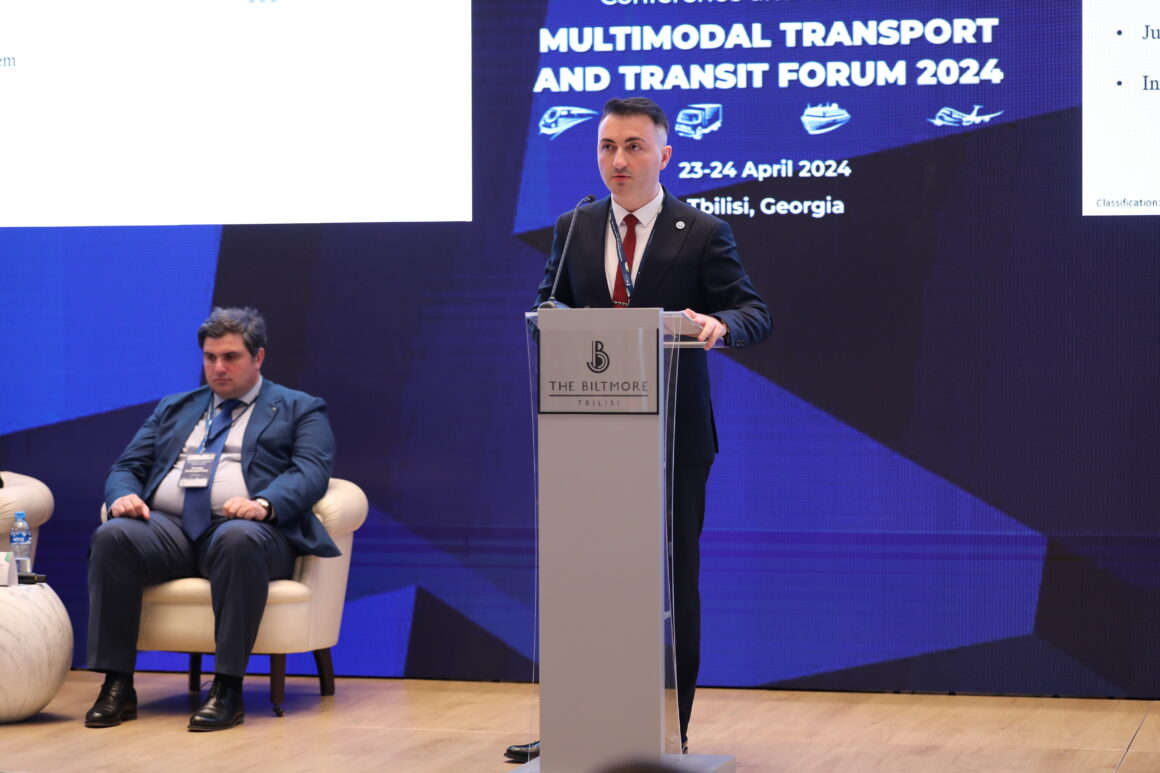
Irakli Danelia, Business Development Manager for the Central Asia and Caucasus region at MAERSK, addressed three key topics, including the transformation of global supply chains through containerization, logistics performance indicators and Maersk’s role as a global logistics integrator on a regional scale. The significant development of containerization worldwide is due to factors such as increasing trade liberalization, technological advances in container technology and significant investment in port infrastructure.
External factors, including geopolitical tensions, the COVID-19 pandemic and logistics disruptions, are having direct and indirect impacts on the Middle Corridor and regional transport conditions. Despite recognizing constraints such as limited digitalization and production delays, transformational trends continue to reshape global supply chains, particularly increasing containerization and standardization across the Eurasian continent. Despite the challenges, proactive strategies are essential to navigate the changing landscape and ensure global supply chains are resilient and efficient.
Against the backdrop of various challenges, the operating environment of global supply chains is shifting towards a “just in case” model, which requires the creation of inventory systems for logistics solutions and significant investments in digitalization. The World Bank’s Logistics Performance Index offers interactive benchmarking tools that identify challenges, opportunities, and operational barriers in different regions and settings.
“Key determinants assessed through the Logistics Performance Index and Corridor Market Assessment include the efficiency of customs and border management, the quality of trade and transport infrastructure, competitive prices for supplies, the competence of logistics services, cargo tracking capabilities and on-time delivery. In Central Asia and the Caucasus, infrastructure and tracking components pose significant bottlenecks and challenges that hinder smooth operations.
In the development of the Middle Corridor, especially for connections with Central Asia, our role as a global container logistics integrator is of paramount importance. Leveraging our extensive experience in logistics solutions including rail, air terminals, supply chain management, warehousing and distribution, we facilitate practical development along the corridor. This includes the provision of block trains from China to Georgia, Azerbaijan, Turkey and Western Europe with containers up to 55 feet in length and regular departures from key railway hubs in China, as well as additional services to Japan and Korea,” shared Irakli Danelia.
MAERSK currently provides regular services from China to Georgia, Azerbaijan and Turkey, offering both block train and FCL solutions tailored to the specific needs and demands of customers. Their goal is to improve connectivity between Central Asia and the rest of the world, using the Middle Corridor as a key route.
“By using Poti as a major gateway for landlocked countries in the Caucasus and Central Asia, we are connecting West Hampshire, Africa, Europe, America and Central Asia through combined rail solutions dubbed ‘ocean plus rail’. Key destinations in Central Asia, including Almaty, Astana, Karaganda, Aktau, as well as Uzbekistan, Tajikistan, Kyrgyzstan and Turkmenistan, are effectively served taking into account customer requirements,” added Irakli Danelia.
MAERSK’s practical solutions ensure seamless transport for customers, offering increased transparency, flexibility and standardization through containerized deliveries. These solutions provide comprehensive tracking capabilities for all stakeholders, including shippers, consignees and intermediaries. In addition, they offer last and first mile truck services, adapting to the geographical nuances of each order and providing connections through Central Asia and the Caucasus to Europe, as well as the Far East, including Japan and Korea.