

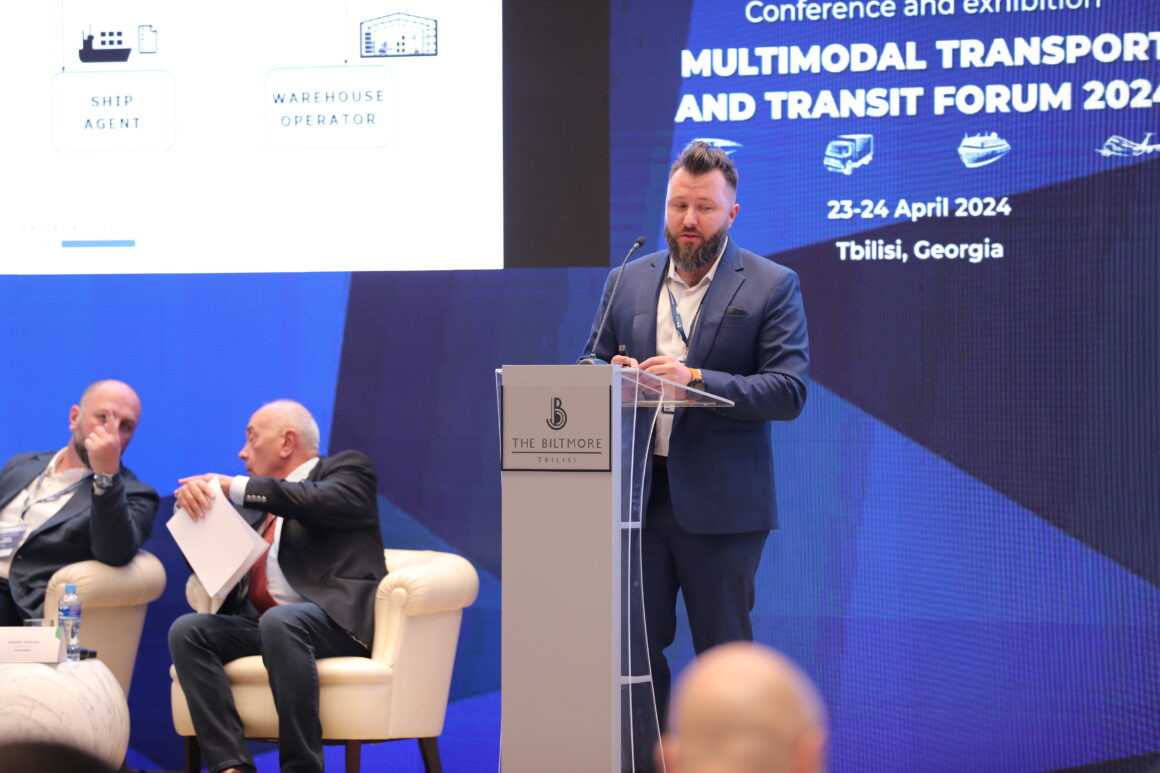
Stanislav Kovaljov, Head of Cargo Insurance at Marine Insurance Services, shared the idea that in modern logistics all participants in the transportation chain should have liability insurance. Stanislav explained it this way: “In the case when the cargo owner has insured his cargo, you must understand, as forwarders, as carriers, that a recourse may come to you in this regard if something happens to the cargo. It is not worth deferring this responsibility to the contractor and relying on his insurance, since the forwarder will still face problems if he does not have his own coverage. Cargo insurance can be organized by the cargo owner independently or offered by the forwarder to its clients, ensuring the convenience of their cooperation.”
However, cargo insurance does not cover delays and additional costs caused by delays, such as business interruption. Such risks require separate insurance, especially for large projects where significant financial losses due to downtime are possible. Cargo owner liability for accidents or damage is also not included in standard cargo insurance policies and must be insured separately.
In addition, conventions such as the Hague-Visby and CMR governing liability in various modes of transport must be taken into account, as well as the possibility of declaring general average. In the event of such events, additional insurance and security requirements arise for cargo owners and freight forwarders. It is therefore important to have a thorough understanding of the risks and liabilities within the supply chain to effectively manage insurance and minimize losses.
In light of the latest sanctions, logistics companies have faced increased inspections and controls. When receiving requests for the transportation of goods, a thorough check is carried out on all parties – sender, recipient, carrier and end user – to avoid possible violations. Banks are also actively involved in this process, which creates additional difficulties for companies.
“A couple of examples. There was a case when the carrier was not to blame for the accident, that is, another car drove into it. Accordingly, CMR, the liability of the motor carrier does not work in this case and the liability insurance of the car owner of the other party begins to work. You must take this into account and understand that if you are a cargo owner, there is a risk that CMR simply will not work.
A reverse example: a freight forwarder client, they insure all cargo, they have 100% coverage for all cargo they touch. The cargo was insured. A cargo of frozen strawberries, worth 18 thousand dollars. The driver turned off the ref. installation for the night, it was just making noise to him. Waking up in the morning, I turned it back on and went to unload – the strawberries were all melted. According to cargo insurance, this is not an insured event, because there are specific conditions regarding the breakdown of refrigeration equipment, but not turning it off. Accordingly, they charged the carrier and received some part of the compensation,” Stanislav Kovaljov gave an example.
In addition, cases where cargo is not insured or insurance does not cover specific situations highlight the need to carefully review the terms and conditions of insurance. Professional insurance and careful planning can protect against financial losses in the event of unexpected events during the transport of goods.
The topic of insurance caused the greatest excitement in the room, as a result of which there were several interesting questions: “So, I’ll describe one situation now, and then I’m interested in your opinion. The cargo was transported by land transport and road transport.
When checking and passing through the customs zone, customs carelessly unpacked the cargo and carelessly threw the boxes inside. As a result, due to improper checking, due to unpacking, the vacuum packaging was broken, the original stowage plan that was in the semi-trailer was violated, and this led to damage to the cargo and goods. Now I’m wondering, the recipient makes a claim to the carrier, the carrier goes to the freight forwarder, and the freight forwarder begins to clarify his issues with the customs service.
Well, everywhere this is a very difficult question. With public services, no one knows what can be achieved, and this process is drawn out, as usual. In this case, when such a moment is recorded, what steps will the insurance company take, in your opinion, that is, how might the situation develop?”
“This is a standard practice, in fact, the insurer will pay compensation, the insurer will demand that claims be presented to the customs authorities, and then it will deal with the recourse itself with the customs authorities. This specifically concerns cargo insurance. This is absolutely no case because there is a guilty party and it would be compensated. There is also a question about responsibilities. The most important point is to file a claim with the customs authorities, because in many cases the client says, I won’t go against customs, I’m afraid, I won’t go. But we need a letter to be drawn up and sent to customs with a claim, even if without an answer.
This has always been the practice with the railroad. They never respond to complaint letters. Accordingly, three registered letters to the railway with a claim were always enough for this to be considered further in court,” explained Stanislav Kovaljov in detail.
The next question concerned insurance of the company’s forwarding activities: “Do you provide insurance for forwarding activities not of a specific cargo, but specifically of the company’s activities? And based on this, the second question. If so, then how important is the question that the carrier who transports this cargo or provides some service has or does not have his own insurance? Because we cannot always control the carrier whether he has valid insurance or not.”
Stanislav Kovaljov replied: “Look, this is the first rule, which 90 percent of insurers will have, that your contractor must have liability insurance. Moreover, speaking of your next contractor, if you hire, say, a carrier through some forwarder, you should only check the forwarder. That is, there is a chain of contracts and the next one in the chain of contracts must be insured. This is the first one.
Second, some freight forwarders’ liability insurers allow uninsured carriers to be taken on as a small percentage of the total.
And third, the cost of a CMR policy is approximately $300 per year per car. If your contractor can’t afford $25 a month, you probably shouldn’t work with him.
This is not only a question of a carrier, a road carrier, it could also be a shipping line or an airline. You won’t always get insurance information from these monsters. You don’t have to check the lines, they definitely have them. From a sea carrier, if you are chartering a steamer, you can ask him, he will provide it with pleasure, because he wants you to take the ship from him. Therefore, they will do everything to make sure everything is normal there. And you can check with forwarders and carriers.”