

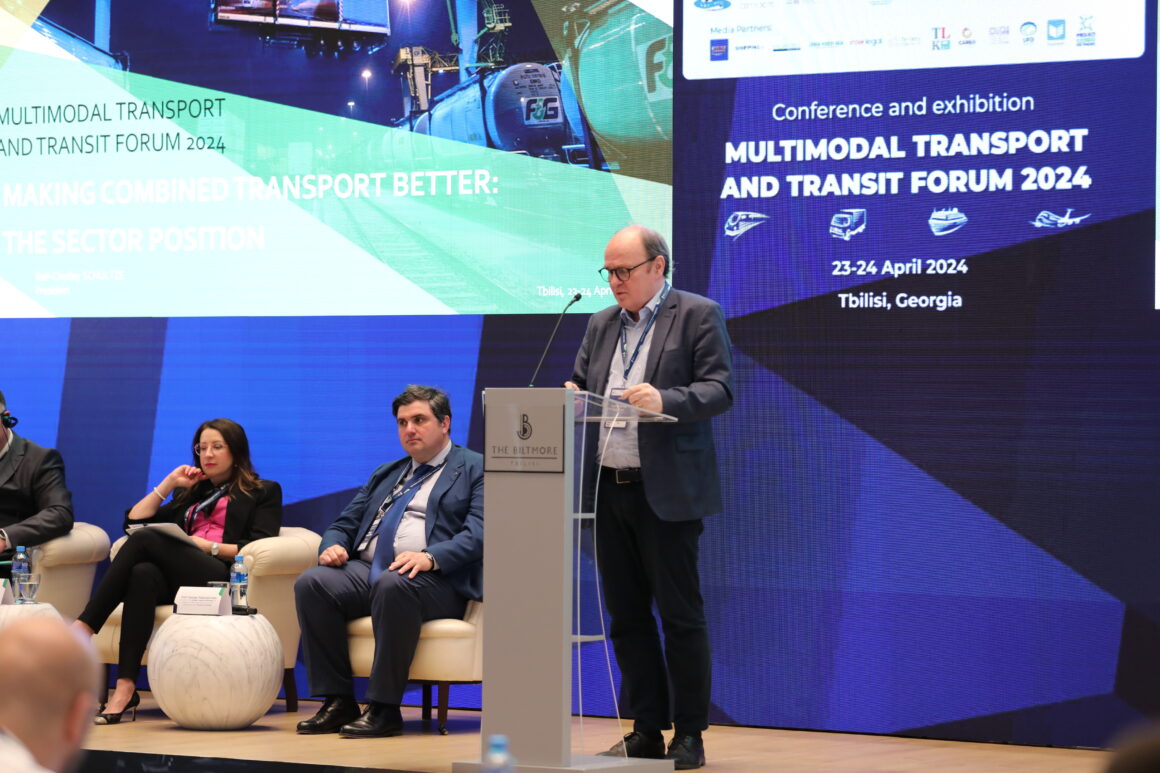
Ralf-Charley Schultze, President of UIRR, spoke about the recently introduced new initiative called “Improving Combined Transport”, aimed at strengthening the industry’s position in Europe. The initiative, proposed by the European Combined Transport Industry Association, represents the interests of both operators and terminal managers in the combined transport sector. Emphasizing the key role of terminals, the association positions itself as a link between rail suppliers and logistics service providers, providing a customer-centric approach to logistics integration.
The association emphasizes the importance of developing partnerships not only within Brussels, but also between member states, and the recent accession of Ukraine demonstrates growing international cooperation. With a focus on advocacy, the association aims to strengthen the voice of combined transport within European institutions and beyond, aligning with initiatives such as the Trans-European Transport Network (TEN-T) and the Green Freight Package. Key legislative efforts include amendments to the Combined Transport Directive and regulations relating to railway capacity management, aimed at streamlining operations and increasing transparency in the industry.
With shared infrastructure for freight, passenger transport and maintenance work, there are concerns about capacity constraints, exacerbated by a backlog of infrastructure projects.
Rail Capacity Management Regulation, recent parliamentary discussions have also highlighted the importance of emissions assessment standards, albeit with voluntary guidelines, prompting calls for more ambitious mandates, especially for smaller companies,” shared Ralf-Charley Schultze.
Particular attention is paid to legislative updates with an emphasis on clarifying the definition and operational criteria for combined transport. The existing definitions, adopted in 1992, have been criticized for their ambiguity, leading to conflicting interpretations and jeopardizing access to compensatory measures. Clarity in the definition of combined transport is becoming paramount in an intermodal context, ensuring fair access and operational integrity in a changing regulatory environment.
“The sector welcomes the Commission’s proposal to expand the scope of combined transport to cover more intermodal operations, including domestic transport. However, concerns remain about the clarity of the methodology and implications for determining external costs. Uncertainty in enforcement mechanisms, especially through electronic freight information platforms, creates challenges that require a balance between simplicity and efficiency.
In advocating a simplified definition linked to the concept of external cost savings, the sector proposes to integrate distance components into the definition until 2035. This involves specifying that the majority of the distance will be covered by off-road transport, with a gradual increase to at least 60% after 2035. Such measures are aimed at stimulating investment in infrastructure and eliminating existing terminal capacity constraints and operational disruptions, emphasizing the need to complete key infrastructure projects such as the Brenner Base Tunnel and Rail Baltica,” noted the UIRR President.
The sector emphasizes the need to take countervailing measures to gradually internalize road externalities, targeting not only CO2 emissions, but also congestion, accidents and other social costs. Such measures, the Ralf-Charley Schultze report argues, should favor rules-based incentives over cash transfers, with a focus on infrastructure investment and creating an enabling environment for intermodal transport. Examples include exemptions from driving bans and infrastructure fees, and funding for terminal construction.
Highlighting the importance of the specific context of Member States, the sector advocates for intermodal development plans to be published and transparently disseminated through the EU information portal. It also requires periodic reporting based on freight transport (FT) data to ensure accountability and consistency across the network. Moreover, it highlights the interplay between weight and dimensions and combined transport directives, highlighting the need for coherent policy objectives to truly improve intermodal transport and reduce CO2 emissions.
Rail stakeholders are closely monitoring the dynamics of the low-density, high-volume segment, recognizing the potential challenges associated with operating cost advantages. The introduction of longer trains, such as the proposed 740-metre trains described in the TEN-T initiative, is dependent on achieving an optimal product mix. Without a variety of cargo types, especially low-density cargo, the viability of longer trains is questionable. This highlights the need for strategic collaboration between the rail and road sectors to ensure a balanced transport network and prevent mode shifts from rail to road.
The debate extends to bilateral agreements on European Modular System (EMS) trucks, where compatibility and cross-border rules come to the fore. Concerns are about the maneuverability of these trucks at terminals and their potential impact on rail travel overall. In addition, allowing heavier fossil fuel-powered trucks to cross the border until 2035 has also caused controversy. While the project was initially intended to encourage investment in battery-powered trucks, the inclusion of diesel trucks raises concerns about environmental sustainability and market dynamics.
In these discussions, stakeholders are advocating for comprehensive capacity management to meet the growing needs of the freight transport sector. Proposals include minimum train length requirements, cargo punctuality standards and simplification of border crossing processes to improve efficiency and interoperability. In addition, the industry’s wish list includes wider infrastructure developments such as a four-metre loading track and bypasses to accommodate future growth and ensure seamless door-to-door transport. Ultimately, the goal is to achieve zero-carbon transport solutions while maintaining a balance between passenger and freight services, not only in Europe but throughout the world.