

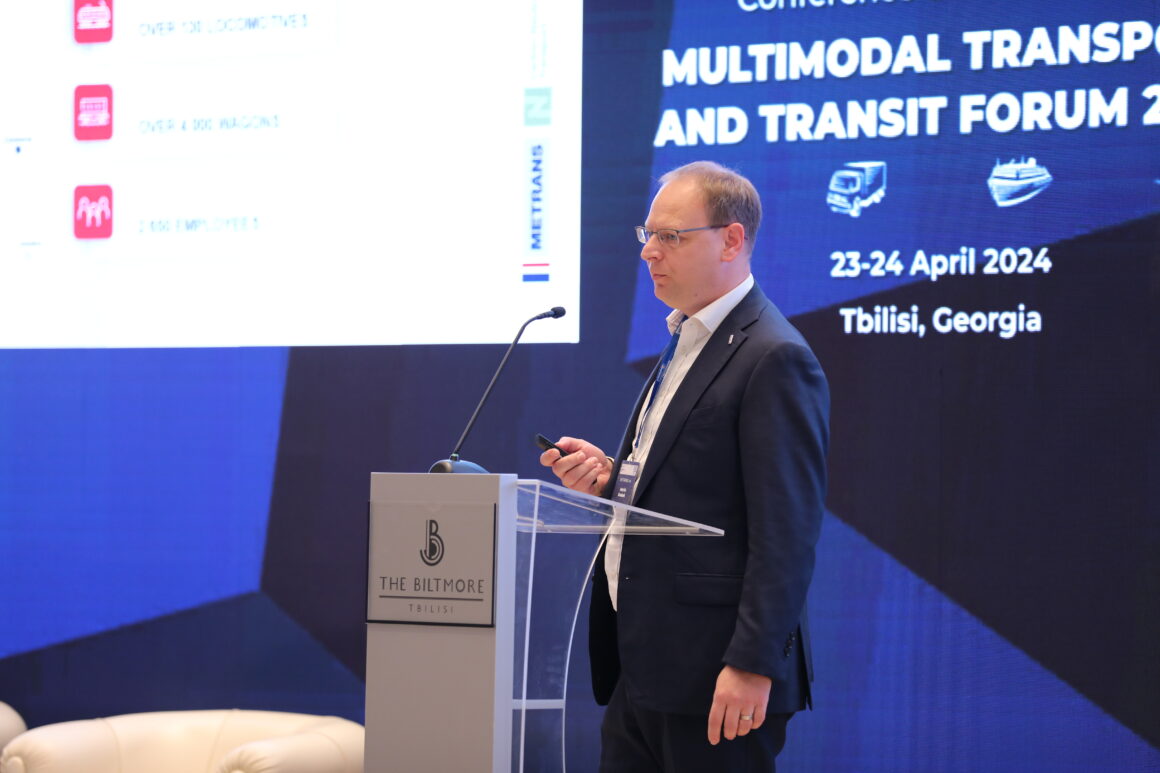
Martin Koubek, Director of the Silk Road and CIS department at Metrans, introduced the company and said that Metrans is a key player in intermodal transport and has been an integral part of the HHLA group since 2018, which is mainly owned by the port organization of Hamburg. Founded in 1991, Metrans boasts over 30 years of experience in intermodal logistics. With annual revenues exceeding €590 million, the company has handled over 1.3 million TEU of cargo and handled 1.2 million TEU in its warehouses with the help of its dedicated team of 2,650 employees.
“One of Metrans’s greatest achievements is its network of 20 terminals strategically located throughout Europe. These terminals serve as vital hubs facilitating the smooth transfer of cargo between trains, countries and different railway systems. It is noteworthy that the company operates a junction terminal in Malashevich, allowing cargo to be transshipped between standard gauge and 1520 mm gauge railways. In addition, Metrans offers a full range of services at its terminals, including container repairs and maintenance of locomotives and wagons. The company is currently the largest private owner of electric locomotives in Central Europe, which underlines its commitment to innovation and efficiency in rail transport,” said Martin Koubek.
In 2022, Metrans achieved an important milestone by establishing a connection to the 1520 gauge network through the Europort terminal in Malaszewicz, expanding its presence throughout Europe. In addition, the company plays a key role in facilitating trade along the Middle Corridor, offering regular rail services to and from Turkey, Serbia and other European destinations, with approximately 650 block trains running weekly.
Notably, Metrans prides itself on its fast and reliable logistics solutions, capable of delivering cargo within one day to any destination in its network. Despite the challenges faced, for example, in the Romanian infrastructure, Metrans remains committed to improving connectivity and ensuring the smooth operation of its entire network, emphasizing its commitment to efficiency and customer satisfaction.
“In our efforts to improve connectivity, we are actively seeking to strengthen ties with Central Asia and China. One of our main goals is to create a road route to Istanbul. With a fleet of over 4,000 wagons, we have the ability to efficiently manage the supply of rolling stock.
In response to issues raised in previous discussions, we recognize the shortage of rolling stock in some regions, a gap that we are committed to addressing. Although our wagons are not 15 and 20 gauge, we remain committed to ensuring a smooth transition by offering viable solutions for onward connections to various destinations,” added Martin Koubek.
Moreover, sustainable development is at the forefront of the company’s initiatives. With products such as HHLA Pure, specifically designed to meet the needs of both large and small businesses, Metrans aims to provide environmentally friendly transport alternatives.
Then came a question from the audience: “So this is a bold look at the future of the middle corridor. Let’s say China shifts the subsidy towards the middle corridor, but there won’t be as much of it in the northern corridor to the east. So the northern corridor will work without subsidies and rather in one direction, one way, right? So this will add $1000 to the current freight price, but I think some customers will be able to accept it. It will be used, let’s say, as a high-end product that will take about 12 days to develop, and the eastbound cargo will move if we can achieve reasonable transit times.
Freight heading east will move along the middle corridor, which will more or less ensure balancing and economic competitiveness of the market. Do you see this scenario as an opportunity and how does Mitrans actually plan to stay in the market? I know that you have opened or are trying to open communications with Istanbul. Is it also the intention to participate in the middle corridor?”.
Martin responded that work is well underway with two weekly services from Dunajska Streda to Istanbul, and they are looking to expand this service by adding a third train between Budapest and Istanbul in both directions. Transit times between Dunajska Streda and Istanbul remain consistently stable at seven days, despite ongoing construction work in Serbia. Looking to the future, barring any changes due to Russian sanctions, Metrans expects a significant advantage for the Middle Corridor. This advantage lies in the equalization of freight flows in the western and eastern directions, which could potentially lead to more competitive tariffs compared to the Northern Corridor.
“And in fact, I believe that the Northern Corridor will probably become a regular service in the coming years, so all the trains will run on schedule, which means that for customers it will be a really competitive solution to rail freight, and then it will be a somewhat mid-range solution for customers who will want to use reliable connections to and from Europe, and then there will be sea freight. So basically there will be a scale of one, two, three that customers can use, and of course then air freight will come first and air freight should be done within, I don’t know, one, two days. And the next one will be this scale, as I described,” concluded Martin Koubek.