

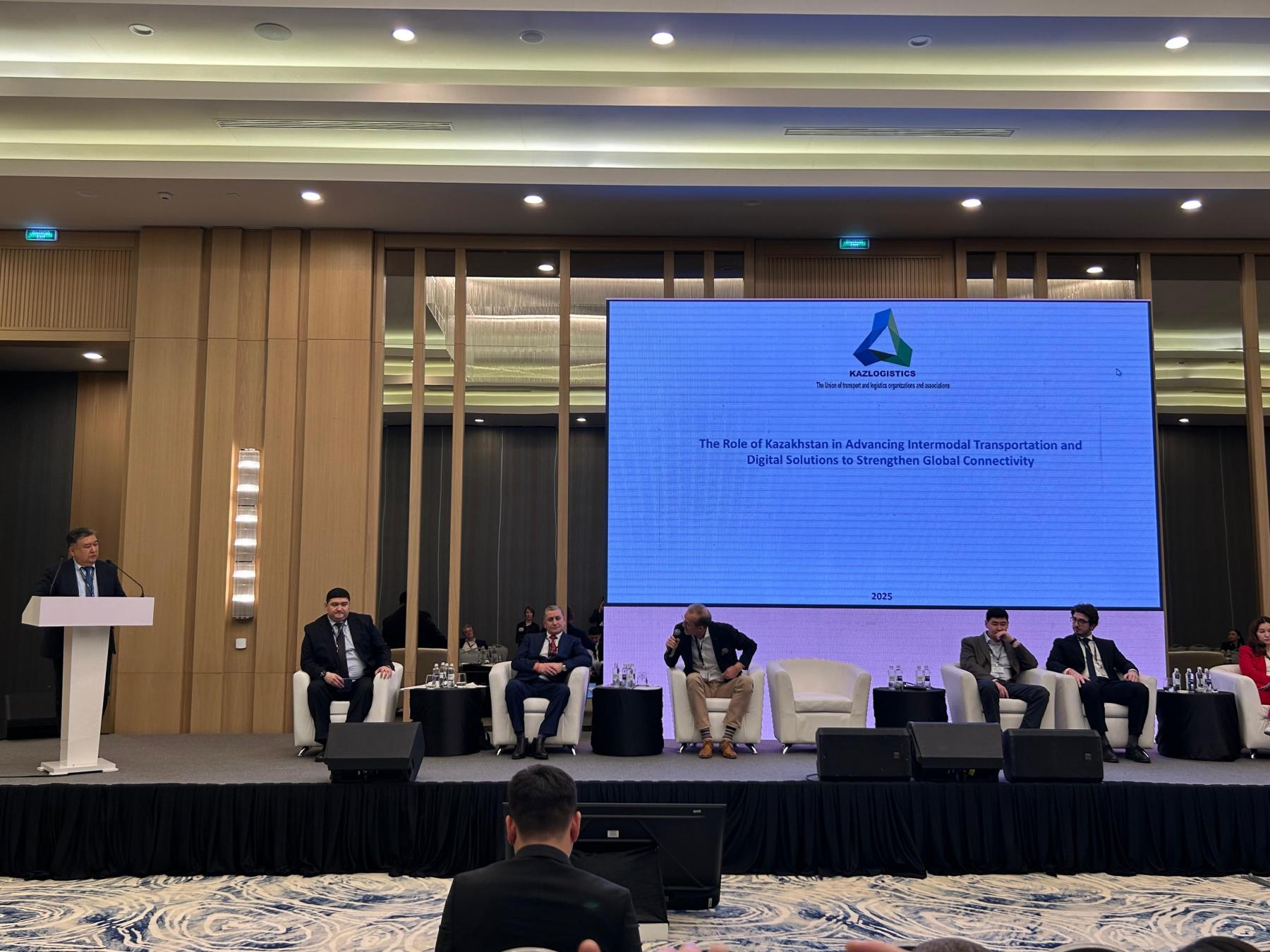
A discussion of Kazakhstan’s strategic role in developing intermodal transportation and implementing digital solutions to strengthen global logistics links was held in Aktau as part of the Caspian Ports & Logistics 2025 international conference. The event, organized with the support of the Port of Aktau and the Trans-Caspian International Transport Route, brought together over 300 participants from Europe and Asia.
Key issues related to developing the country’s transport and logistics potential and the Middle Corridor were discussed at the Caspian Intermodal Transport session. Zhaslan Zhagparov, Deputy General Director of the Union of Transport Workers of Kazakhstan “Kazlogistics,” delivered a presentation, noting that Kazakhstan is currently involved in five international rail and eight road transit routes. According to him, in the first 10 months of 2025, the volume of transit traffic through the country increased by 4.5% to 29.42 million tons, reflecting the growing interest of global shippers.
The speaker highlighted significant infrastructure and technological achievements in recent years, including a fivefold increase in throughput capacity on the Dostyk-Moiynty section, the development of dry ports and logistics hubs in Zhetygen, Poti, and the Tashkent region, the expansion of the Aktau and Kuryk ports, and the development of a network of international terminals in Lianyungang, Xi’an, and Poti, as well as new sites in Selyatino, Svisloch, and Tashkent. Particular attention was paid to the increase in containerization from 4% in 2021 to 7.5% in 2025, the development of export container services, and the digitalization of the industry, including the implementation of intelligent control centers, computer vision systems, and AI solutions. According to Zhaslan Zhagparov, these measures strengthen Kazakhstan’s position as a key Eurasian logistics hub and enhance the sustainability and competitiveness of regional routes.