

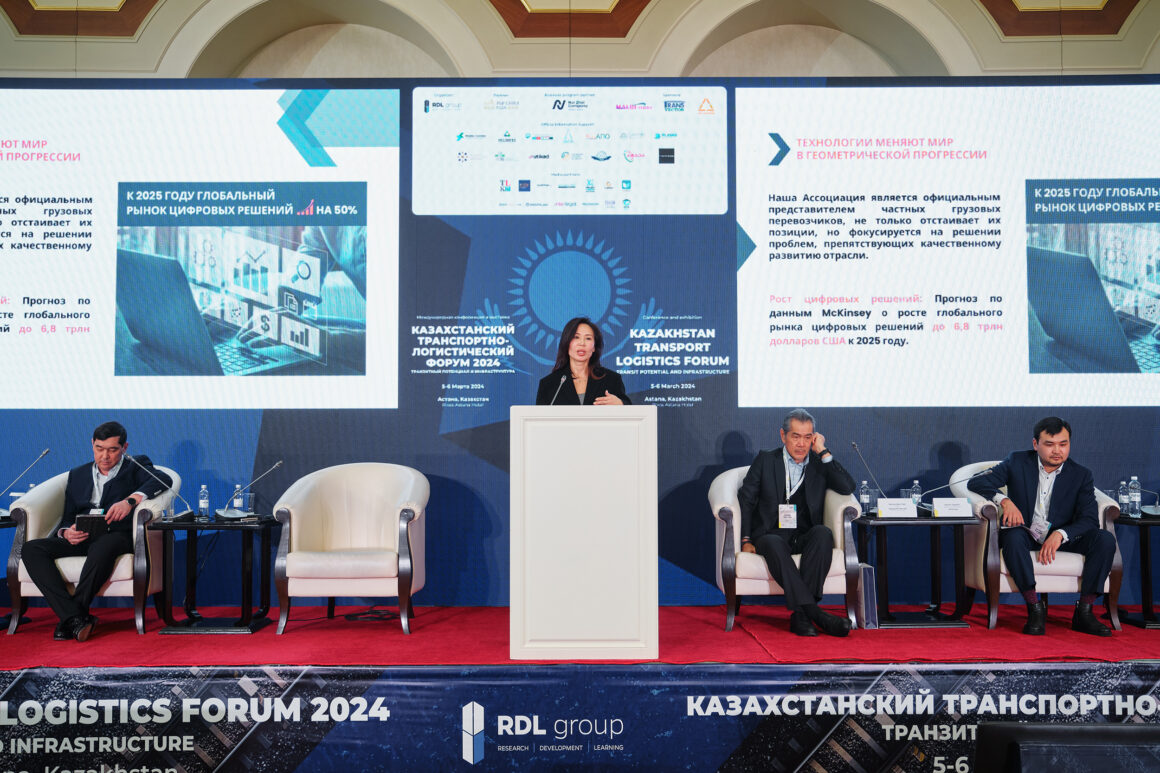
Saraeva Ramiya Aslbekovna, General Director of the Association of Kazakhstan Railway Carriers and member of the STC KazLogistics, spoke on the topic “The role of Kazakhstan in international transport logistics and integration into leading international digital products.” She said that since 2018, Kazakhstan is the only country in the CIS that is open to competition in the freight transportation market. At the same time, the Association of Kazakhstan Railway Carriers, being a young project, which is only 3 years old, provides an opportunity for companies with locomotives and rolling stock to act as cargo carriers in the country.
“Our numbers speak for themselves: the global digital solutions market is expected to grow by 50% by 2025, according to McKinsey forecasts, and global digital solutions market growth will reach US$6-8 trillion by then. Last year, the President of Kazakhstan announced his desire to make the country an IT state, which emphasizes the active development in the field of digitalization,” noted Ramiya Aslbekovna.
Since 2018, great opportunities have opened up for startup projects, the Astana Hub digital hub has been operating, and the export of digital products from Kazakhstan has reached $500 million. Today Kazakhstan can already be safely called an IT country, and the Association plays its role in this development process.
On the territory of Kazakhstan, digitalization is actively developing in the transport and railway industries. Recently, on the basis of KTZ, together with Huawei, a new situation center called “Smart Railway” was opened. This center allows you to monitor and control all processes from the collection of goods to their transportation, providing the ability to make adjustments and comments. Cooperation between Huawei and KTZ is aimed at data exchange and complete modeling of the digital road.
In addition, together with the Singapore company PSA, a digital seamless transit corridor was launched last year on the TMTM route. This process significantly saves time for transit customers, ensuring cargo safety and increasing customer and shipper satisfaction.
Digitalization technologies are also being actively integrated to ensure the efficiency of various modes of transport. The Kazakh government is calling for the creation of digital maps and the definition of five-year development plans for each line ministry, which contributes to the overall strategy for digitizing the economy.
Companies such as Darail and Silkway Transit are implementing automated transportation process management systems, which allows them to effectively monitor and control all stages of cargo transportation, from billing to commercial activities. Darail became the first and so far the only company in the CIS to modernize its systems in this direction.
“In Kazakhstan, in addition to the positive aspects, there are certain problems that should also be mentioned. There is heterogeneity between the private and public sectors, where almost all new products and initiatives coming from the state are financed by the quasi-public sector, which influences policy in the digital sphere,” said Ramia Saraeva.
Although the private sector is also ready to integrate with the national company KTZ for the development and implementation of digital products, the state must create conditions for this. Thanks to the joint implementation of instructions from the government, the country can continue to develop and compete with other countries in the digital sphere.