

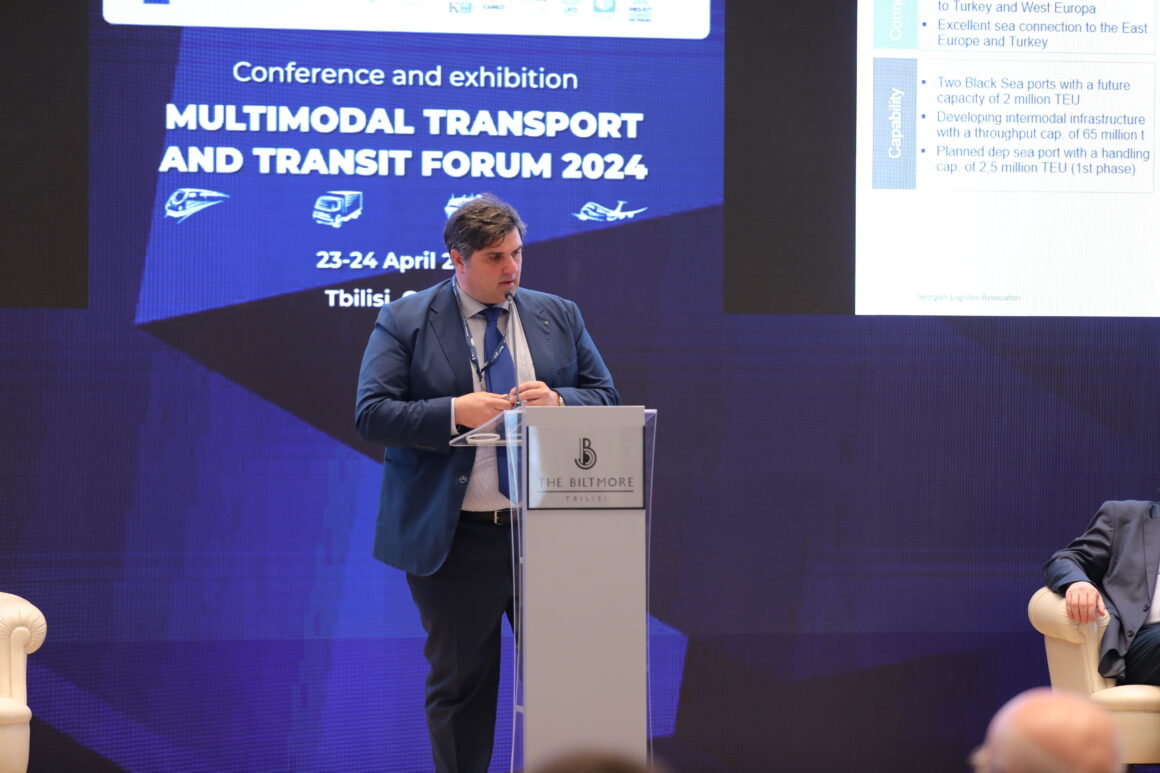
George Doborjginidze, Chairman of the Georgian Logistics Association, provided an overview of the key opportunities, bottlenecks and weaknesses that need to be addressed to ensure the smooth movement of goods along the Middle Corridor.
Georgia plays a crucial role as a natural hub in the South Caucasus, offering the shortest sea routes from Central Asian countries to Eastern Europe. With ports in Poti and Batumi, Georgia acts as a major gateway for the countries of the South Caucasus and Central Asia.
Recent infrastructure development in Georgia, including rail links with Turkey via the Baku-Tbilisi-Kars railway, underscores its importance as a transit link. In addition, Georgia plans to expand transit container traffic and increase the capacity of its ports to potentially handle up to two million TEUs in the future.
The ongoing modernization of the Georgian Railway aims to increase future capacity to 65 million tons, further strengthening Georgia’s role in facilitating regional trade. Currently, we are seeing a significant redirection of traffic flows towards the South Caucasus transport corridor with a noticeable 30% increase in road transport and dynamic growth in container transport. However, this growth also creates challenges, particularly at border crossings, that must be addressed to maintain the corridor’s effectiveness.
In 2023, Georgian ports reached record levels, handling a total of more than 700,000 TEUs in Poti and Batumi. The trend towards increasing cargo volumes opens up significant opportunities for the transport and logistics industry. However, it also highlights the urgent need for improvements that will allow for smoother movement of goods, shorter transhipment times and lower costs.
“Rail transit also showed a remarkable growth of 30%, indicating further growth potential. However, the current low level of containerization in Georgia, the South Caucasus and Central Asia, estimated at less than 5%, highlights the huge untapped potential for the movement of containerized goods. Developing adequate infrastructure to support this growth is a prerequisite for future success,” shared George Doborjginidze.
Despite the increasing growth of road transport, border crossings, especially between Azerbaijan and Georgia, face congestion problems. Initiatives by the border authorities of Georgia and Azerbaijan are aimed at expanding capabilities and streamlining procedures to speed up cross-border processes. Georgia stands out as a pioneer in the region due to its efficient border crossing procedures, with average border crossing times ranging from two to four minutes.
However, as transport flows continue to increase dynamically, capacity limitations at Georgian ports pose a major constraint. While there is potential to handle an additional 150,000 TEU, current constraints require urgent capacity improvements to maintain the corridor’s growth trajectory.
“There are notable bottlenecks in the Middle Corridor affecting operations in the Caspian Sea, which historically were intended for the transport of bulk cargo. However, with growing faith in future containerization on this route, there is an urgent need to expand container transport capacity. This involves not only improving the infrastructure for container transshipment in ports, but also ensuring sufficient throughput of specialized container ships,” noted George Doborjginidze.
A key observation is the lack of intermodality in Georgia, the South Caucasus and Central Asian countries. Efforts to improve the efficiency of intermodal transport are critical to creating better conditions and attracting more container traffic. The rolling stock shortages experienced in 2020 and 2021 due to the rerouting of bulk traffic highlight the need for more efficient and reliable rail connections to ports.
Digitalization is becoming a key solution for optimizing logistics processes and reducing transshipment time between modes of transport. By integrating digital technologies, the Middle Corridor can improve logistics operations, attract more goods and improve conditions for future freight movements. Addressing capacity issues, particularly in rail, Caspian and Black Sea operations, is a top priority to ensure the viability and success of the corridor.
“Large-scale infrastructure development is underway in the ports of Azerbaijan and Kazakhstan. However, there remains ample scope for future improvements, particularly in optimizing exchanges between railways, ships and maritime operations. Time is of the essence in supply chains, so it is necessary to focus on potential time-saving measures when changing modes of transport,” recommended George Doborjginidze.
The expansion of rolling stock and railway infrastructure continues, and ongoing projects in Kazakhstan, Azerbaijan and Georgia are designed to rapidly increase railway capacity. Efficient rail-port connectivity is critical to streamline operations. In Georgia, major projects include the development of a logistics center in Tbilisi, led by the Asian Development Bank in partnership with the Georgian government and private investors. This center will have direct access to the Baku-Tbilisi-Kars railway and strategic proximity to neighboring borders.
Modernization of Georgia’s railways continues, with the goal of expanding the network’s future capacity to 65 million tons while increasing train speeds. In addition, plans to build a new deep sea port in Georgia, which is currently undergoing a tender, highlight the government’s commitment to infrastructure development through public-private partnerships. Increasing port capacity is considered necessary to improve the competitiveness of the corridors and ensure efficient connectivity between the South Caucasus, Central Asia and Eastern Europe.
At the end of the speech, there was a question from the audience: “What is the status of the Anaklia Port, at what stage is it? Because I think that back in 2018-19, there was a road show on the port of Anaklia, because the power of Poti and Batumi is not enough. What about the status of the Anaklia port?”
“Regarding the status of the Anaklia port, the government has initiated a new tender to select investors for its development. The contract with the government of the previous consortium responsible for the development of the port was interrupted, which necessitated a new tender. The first stage of development involves the creation of two container berths with a total capacity of 500,000 TEU, and in further stages it is planned to expand capacity.
In addition to the development of the new port, it is planned to increase the capacity of the existing port of Poti and the container terminal in Batumi. The port terminal in Batumi is operating efficiently and its capacity is planned to be expanded. Although the port of Poti in the city has limited potential for expansion, innovative strategies are being explored to maximize its current capabilities. With existing ports, capacity could potentially be increased to one million tonnes given the rapid growth in cargo traffic.
Looking to the future, the development of a new port in Anaklia is considered crucial in the medium to long term, not only for Georgia, but for the entire corridor. This new infrastructure will play a vital role in meeting the growing demand for transport and improving the efficiency of the entire transport network,” responded George Doborjginidze.