

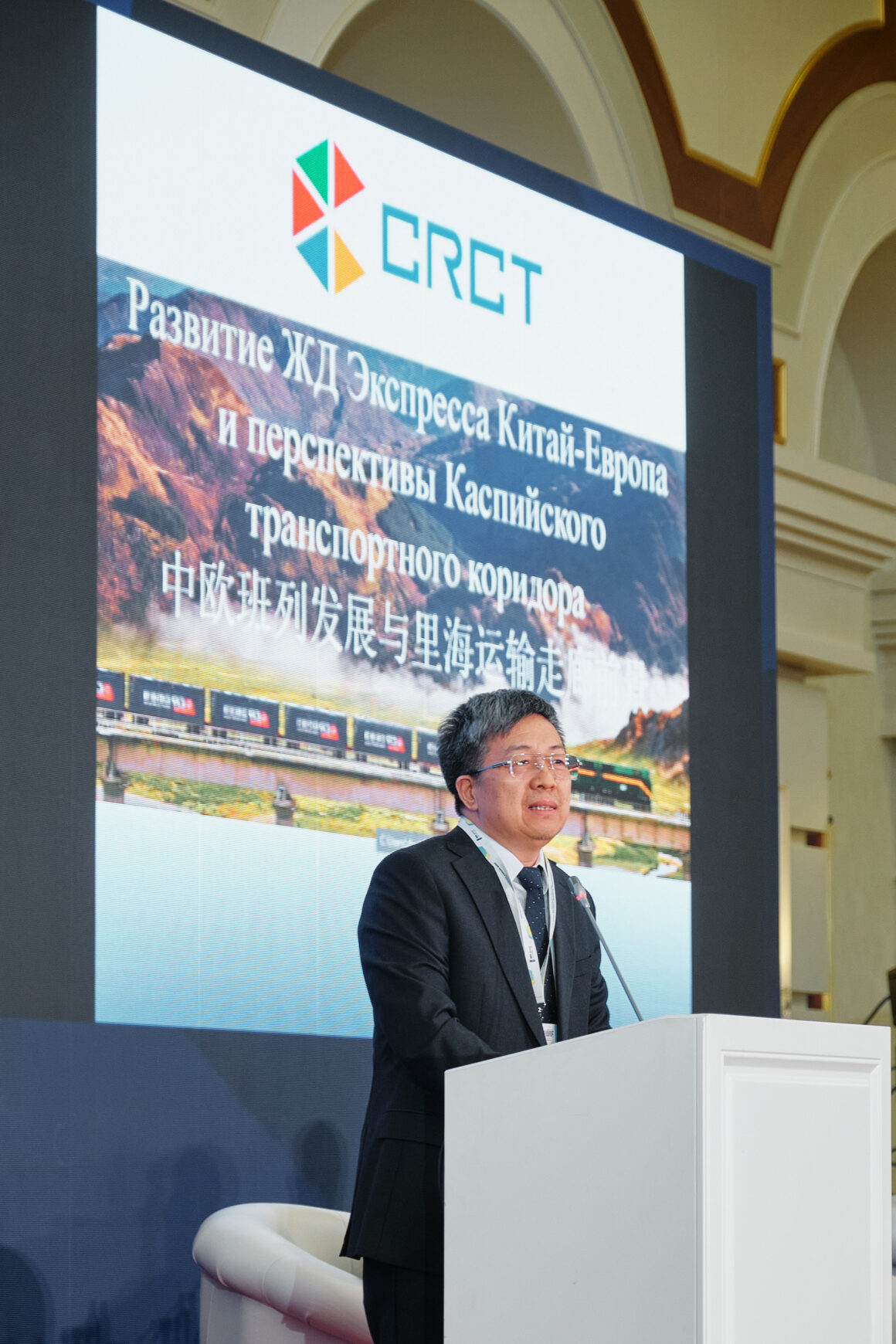
Hao Guoqi, General Director of CRCT Kazakhstan, which is part of the China International Transport Corporation and operates as an integrated logistics service platform covering the Eurasian continent, operating container trains throughout Central Asia, the East and the West.
CRCT Kazakhstan oversees container train operations in 12 countries, including Kazakhstan, Uzbekistan, Tajikistan, Kyrgyzstan, Turkmenistan, Afghanistan, Azerbaijan, Armenia, Georgia, Iran, Turkey and Pakistan. Their focus covers four key components:
- transport and forwarding services,
- container processing and management,
- rail transportation between China and Kazakhstan,
- facilitating the return of containers from other countries to China.
Given train developments and current challenges in the TMTM corridor, their priority is to improve container train connectivity between China, Europe and other global destinations. The number of container trains between China and Europe has increased significantly, reaching 82,000 between 2014 and 2023, with a significant increase in cargo volume, amounting to 1.9 million tons. In addition, there has been a steady improvement in operational quality, as evidenced by the increase in average train length to 52 cars.
In addition, the range of goods transported has expanded to include more than 53 categories and 50,000 types of goods, including mechanical equipment, automobiles, furniture, clothing, chemicals and medical equipment. Trade turnover reached $75 million in 2023, reflecting the growing importance of these transport routes. Transport operations between seven countries such as Xi’an and Duisburg have been optimized, ensuring more stable and reliable transportation. Overall, the goods transported have become more competitive, highlighting the increased efficiency and effectiveness of their logistics operations.
“When it comes to service quality, we are constantly striving to improve. Enhanced tracking capabilities, streamlined container return processes and multiple container return locations provide a better experience for our customers. We prioritize customer comfort by offering comprehensive container insurance services, ensuring the security of transactions.
Our information infrastructure is constantly evolving: an electronic help desk and an information platform for container tracking are being introduced. In addition, we have established an information service and quality assessment center to provide customers with a full range of services,” noted Hao Guoqi.
As for the TITM corridor, against the backdrop of the ongoing conflict between Russia and Ukraine, this route has gained prominence, attracting the attention of governments and stakeholders. The Chinese government is actively promoting the TMTM, especially the middle corridor. Last year, a task force that included a Chinese delegation visited the ports of Poti and Aktau to resolve the corridor’s problems.
However, challenges remain in the TITM corridor, especially related to the complex network involving rail and maritime segments through Kazakhstan, Azerbaijan and Georgia. Customs clearance in many countries and the unpredictable nature of transport logistics create additional obstacles. Despite these challenges, well-managed container freight services can mitigate problems along the entire corridor route. In addition, the overall cost of travel along the TITR corridor is not yet competitive with the northern route.
Hao Guoqi proposed several initiatives to improve operations:
“First, establish a joint venture with freight forwarders and stakeholders to coordinate TITM activities, including tariff management. The participation of the Chinese railway company in this venture will streamline operations, leading to reductions in travel times and tariffs.
Secondly, develop a unified information platform to facilitate the transfer of customs data along the middle corridor. This platform will optimize processes and reduce costs associated with information exchange.
Third, adopt a standardized transport document along the corridor to speed up transit and reduce costs.
Fourth, promote new construction projects and attract investment to improve infrastructure between the ports of Aktau, Poti and Batumi, including the expansion of container capacity.
Fifth, increase the volume of reverse transportation and expand the car fleet to reduce transportation costs.
And finally, promote cooperation between railways, trade organizations and other stakeholders to improve logistics, enhance safety and reduce trade barriers, which will ultimately create a more favorable environment for TMTM between China and Europe.”