

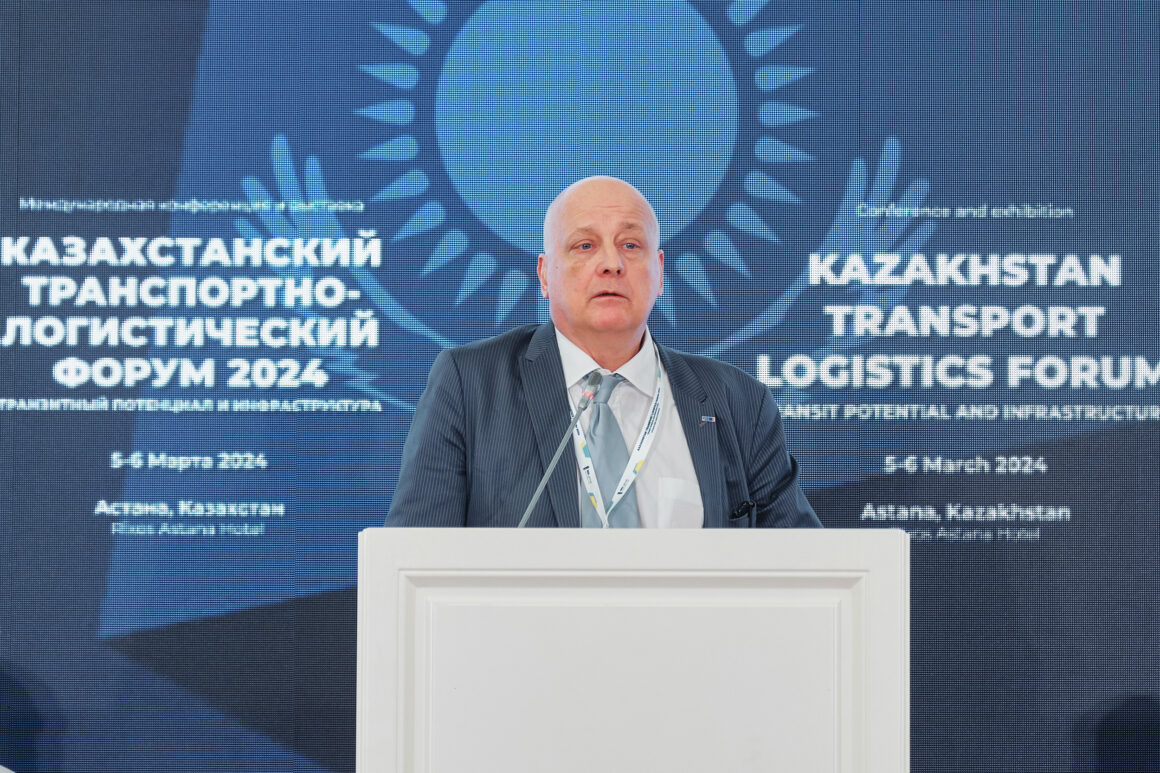
Vincent Hascoet, expert on intermodal and strategic business development in the EMEA – CIS region at HHLA Project Logistics, presented the Port of Hamburg in Kazakhstan. He began his speech with the fact that Kazakhstan is of strategic importance as a crossroads of important trade routes connecting various regions. It is also noted that HHLA pays special attention to oversized shipments, which are becoming increasingly in demand in the context of changing geopolitical circumstances.
Historically, the main route for oversized shipments has been the Volga-Don Canal, but sanctions and restrictions imposed on it limit customer options. Therefore, the route through the Middle Corridor, which includes Kazakhstan, the Caspian Sea, the Far Caucasus, Azerbaijan and Georgia, represents an alternative that excludes passage through Russian territory.
With increasing demand and volume of cargo, it is important to consider different routes and delivery methods. One such option is air freight, especially given the presence of a large fleet of airliners in the Caucasus and Central Asia. However, it is worth considering restrictions and costs, including demurrage and other nuances that may affect the efficiency and economic efficiency of transportation.
In addition, it is worth paying attention to the variety of sea routes through various ports such as Istanbul, Malta and Greece, as well as the ro-ro connection with the port of Constanta. In light of the growth in cargo volumes and the development of APM Terminals, it is important to invest in expanding capabilities, although the project to build a third port in Georgia is currently on hold.
Vincent Hascoet also spoke about specialization in the Caucasus corridor:
“We are generally specialists in the Caucasus corridor. And it must be said that the Caucasian corridor is provided not only by Kazakhstan; in general, only 20% of the goods that enter there go to Kazakhstan. The most important ones are Turkmenistan, of course, but not only. Still all central Asian countries.”
HHLA also provides connectivity to Turkey via the Caspian Sea, where a large number of vessels are available for charter. The Alyat port in Baku is the main hub for receiving and sending cargo, having wide capabilities. Options through Turkmenbashi, Aktau, Kuryk and Bautino are also being considered for various types of cargo, including oversized cargo.
Vincent also spoke in more detail about the Port of Hamburg, which has been around for 850 years and is an important logistics hub with a long history.
The port has 4 directions:
- The first is container. This is the management of marine terminals, cooperation with the entire shipping line, including MSC.
- The second is intermodal. They have a branch here called METRANS. They are number one in Europe for creating container block trips.
- Third is logistics. HHLA Project Logistics of Kazakhstan specializes in oversized and other freight-forwarding tasks.
- The fourth is historical, as Vincent said: “… because we are the city of Hamburg, we have a fish market and so on, and this will also bring us some income.”
The port specializes in container transport and oversized cargo, offering a wide range of services, including marine terminal management and logistics.