

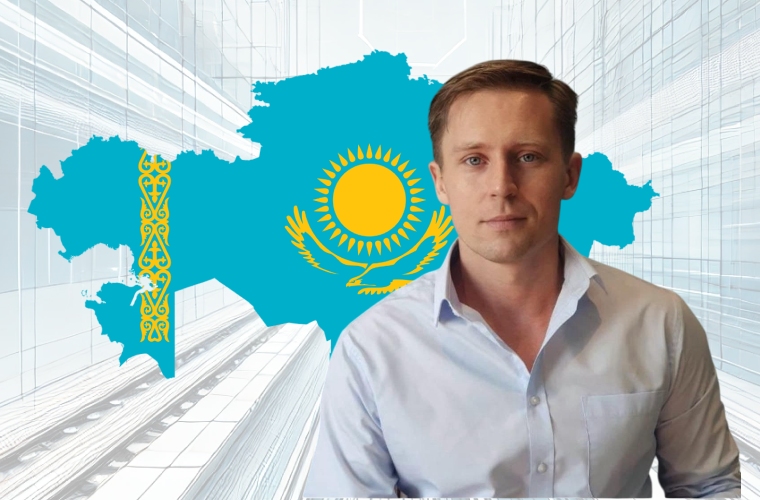
Today we are talking with Andrey Stepaniuk, General Manager of SYNEX Logistics in Kazakhstan. SYNEX Logistics is a 3PL operator from Ukraine, part of the Eclectic Talents Group. In Kazakhstan, SYNEX Logistics provides services for the transportation of goods by all types of transport, customs clearance and accelerated border crossing.
- What do you think are the key factors influencing the development of logistics in Kazakhstan? How does this affect new international sanctions and trade routes?
The sanctions imposed on the Russian Federation have a significant impact on the vector of development of logistics in Kazakhstan.
Until February 2022, the ports of the Russian Far East, such as Vladivostok, Nakhodka, and Vostochny, were actively used to transport goods from China to Europe. There, containers arriving by sea were loaded onto the railway and followed through the territory of the Russian Federation to European countries.
Today, a significant part of this cargo flow goes to Europe through the territory of Kazakhstan, including through the increasingly popular Trans-Caspian International Transport Route.
TITR originates in the Chinese port of Lanyungan, cuts through the territory of China and Kazakhstan through the Altynkol railway station. Having reached the piers of the ports of Kuryk and Aktau, the route crosses the Caspian Sea, entering the territory of Azerbaijan, and then Georgia. Then the route goes to European countries, either through the Black Sea, or by land, through Turkey.
Along this route, it is possible to transport goods not only by rail, but also by road.
- How do logistics processes differ in Europe, Asia and the CIS countries?
The legislation regulating international transportation is unified and largely complies with accepted international standards, so I will not surprise you with any exclusive information here. However, when we talk directly about Kazakhstan, we need to be extremely careful when choosing a logistics company, since there are a lot of them on the market and there are often cases of fraud or failure to fulfill obligations to the client.
Cultural features and rules of doing business in Kazakhstan often require personal contacts, so the presence of representatives of a logistics company, for example, on the border with China, can significantly speed up the passage of queues, which are not uncommon in our country. For example, thanks to our representatives at the Nur Zholy checkpoint, we were able to set a record for the speed of cargo delivery by road – 10 days from the Chinese city of Shenzhen to the capital of Kazakhstan – Astana.
- How do you assess the role of Central Asia in the global logistics chain?
Central Asia occupies a key place in the global logistics chain due to its strategic location between Europe, China and the Middle East. Interest in Central Asia is growing as an alternative route against the backdrop of geopolitical instability, and its resources, including energy resources, strengthen the role of the region. However, challenges remain, primarily the underdeveloped infrastructure of checkpoints and ports, after the development of which the throughput capacity, and accordingly the role of the region in logistics chains, will be even more significant.
- How do you see the next stages of SYNEX Logistics development in Kazakhstan, is expansion planned in other Central Asian countries?
We have ambitious plans, and we see SYNEX Logistics as a leading player in Central Asia, providing European-level service. Our young and ambitious team brings together real professionals, which allows us to confidently move forward. Today, our office in Kazakhstan already provides cargo transportation services by all types of transport, customs clearance, and accelerated customs border crossing.
- Do you think the future is in automation or will humans still remain the key link?
The future of logistics is certainly connected with automation. Modern technologies such as artificial intelligence, warehouse robotization and automated supply chain management can significantly increase the efficiency, speed and accuracy of processes. However, humans will remain a key link, especially in such aspects as making strategic decisions, managing complex situations and building relationships with clients. Automation will take over routine tasks, allowing specialists to focus on analytics, creative solutions and innovations. The balance between technology and the human factor is the key to sustainable development of logistics.