

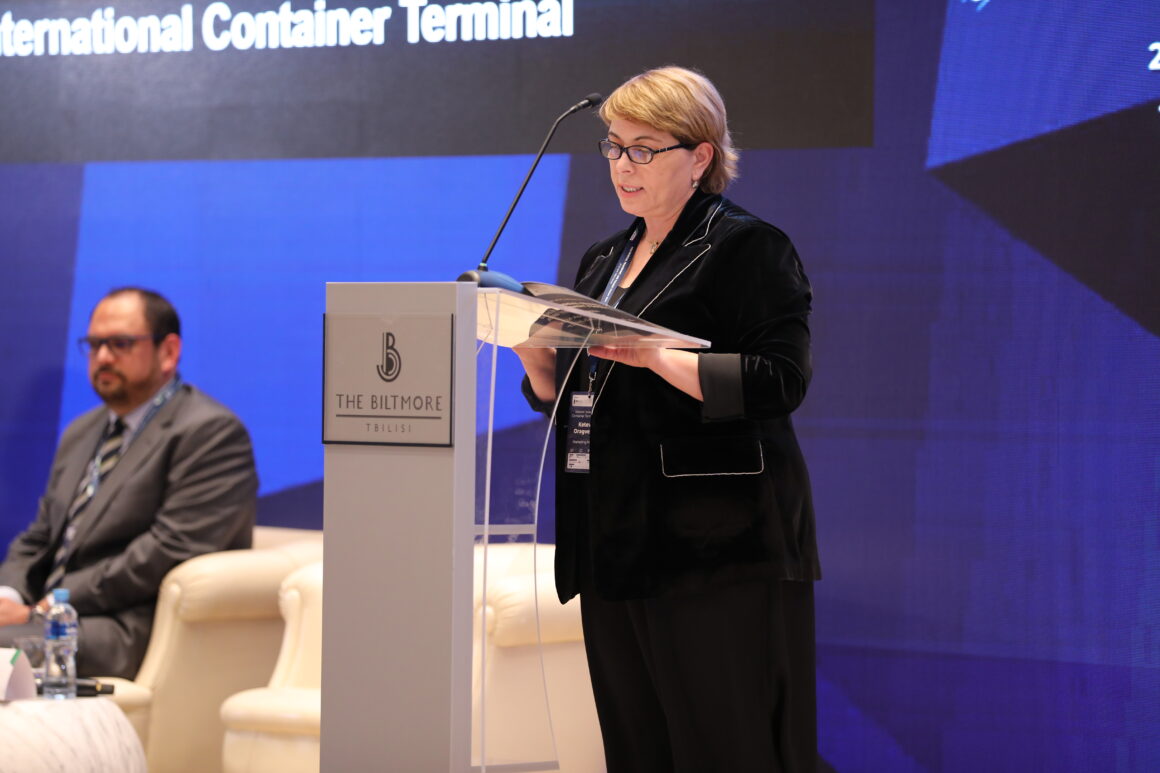
Ketevan Oragvelidze, Marketing Manager of Batumi International Container Terminal, spoke on the topic “Growing the potential of Georgia as a sea and land transport hub.”
“Imagine a port where all aspects of efficient cargo handling are seamlessly integrated into one place – that’s what you’ll find at BICT. Under the auspices of ICTSI, the Philippines’ largest port operator, BICT entered into a 48-year lease in 2007 to establish and operate a container terminal, ferry bridge and general cargo transhipment complex at the seaport of Batumi. Since its inception, BICT has witnessed exponential growth: its container terminal capacity has tripled and is now projected to handle approximately 230,000 TEU per year,” Ketevan presented.
At BICT, all stevedoring operations, handling, storage, delivery or receipt of containers and cargo take place in one place, which is a distinctive feature of Georgian ports. The customs post located on the territory of the terminal speeds up the clearance of goods, ensuring fast processing. Unlike APMT, which both owns and operates the port, BICT operates exclusively at the Batumi Seaport, with the port itself controlling related costs and services.
Batumi seaport, located at the top of a natural deep-sea canyon, has a stable draft of 11 meters and does not require constant dredging. Combined with favorable weather conditions and minimal closures, the port is using four tugboats to service vessels. BICT boasts state-of-the-art container handling facilities, newly upgraded infrastructure and expanded railway capacity, demonstrating its commitment to efficiency and innovation in cargo management.
Within Batumi lies a terminal that has the potential to revolutionize shipping efficiency and economic growth. Batumi International Container Terminal serves as a comprehensive hub, seamlessly integrating cargo loading, unloading and delivery in one centralized location. Unlike other ports with remote docking facilities, BICT acts as a completely independent operator, optimizing operations within its borders.
“BICT’s unrivaled dock capacity and berth expansion capabilities ensure minimal vessel delays and optimal cargo handling. With container belt utilization currently at just 22%, the terminal boasts sufficient space to accommodate increased cargo volumes and a capacity of 25 movements per hour. In addition, the strategic BICT rail link ensures seamless transport connectivity from Asia to Europe through the Middle Corridor,” Ketevan noted.
Recent service improvements, including expanded MSC connections to North Africa and Spain, highlight BICT’s key role in global maritime networks. Despite challenges such as the inactive Ukraine Corridor, which accounted for a significant portion of cargo volumes, BICT remains steadfast in its commitment to ensuring seamless trade and transport routes between Asia, Europe and beyond.
“In conclusion, the discrepancy between BICT’s underutilized capacity and ship delays at other Georgian ports highlights the inefficiency of the supply chain. Despite BICT’s ability to provide cost-effective services, low tariffs and the presence of some interests lead to inflated costs along the corridor, which ultimately affects end users. Solving these problems through joint efforts is important to increase efficiency, reduce costs and improve the overall competitiveness of the corridor for all parties involved,” concluded Ketevan Oragvelidze.