

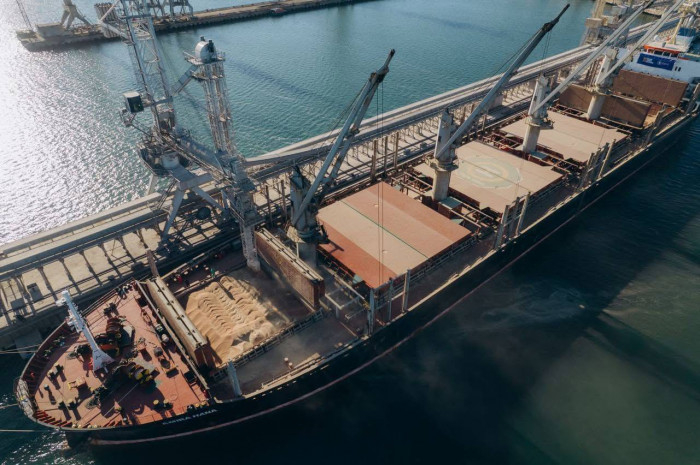
Despite Russia’s targeted attacks on ports, railways, and logistics hubs in 2025, Ukraine’s transport infrastructure not only remained operational but also demonstrated development. This was stated by Oleksiy Kuleba, Deputy Prime Minister for Reconstruction of Ukraine and Minister of Communities and Territorial Development, summing up the year. Water logistics remained the key export and import route: total transshipment volume amounted to 76.1 million tons, of which 67.8 million tons were handled by the ports of Greater Odesa. The Ukrainian Maritime Corridor retained its status as the main export route: since its launch, over 163 million tons of cargo have been transported through it, including approximately 100 million tons of agricultural products.
Inland waterways and the Danube route assumed special importance in 2025. Over 8.2 million tons of cargo were transshipped through the ports of Izmail, Reni, and Ust-Dunaisk, diversifying exports and reducing the burden on land crossings. The efficiency of the Ukrainian Danube Shipping Company increased significantly: the number of convoys increased by 3.8 times, average monthly shipment volumes by 43%, and the share of return vessel loads doubled. Operating losses were also reduced by 1.5 times, and administrative expenses by half. At the same time, major investment projects were launched, including the preparation of a public-private partnership at the port of Chornomorsk with potential investments of up to $300 million, as well as the attraction of $35 million in grants under the RELINC program and €50 million in EU funding for the modernization of port and logistics infrastructure.
The railway sector actively integrated into the European transport system throughout the year. A key event was the completion of the first European-gauge railway line since independence, on the Chop-Uzhhorod section, providing direct connections with Austria, Slovakia, and Hungary. International train capacity increased by 20%, new routes to Bucharest, Przemysl, and Kholm were opened, and 66 new sleeping cars were delivered. Road transport stability was ensured by the extension of the visa-free regime with the EU until March 2027 and liberal regimes with several countries, while the “eCherga” system, covering all cargo border crossings, recorded over 2.6 million border crossings. Additionally, electronic consignment notes were reinstated, the “eKonkurs” procedure for passenger transport was introduced, 10 small border crossing points were modernized using a modular approach, and a new border crossing point, “Velyka Palad,” was opened.