
METRANS launches south Poland – north Slovakia rail service.
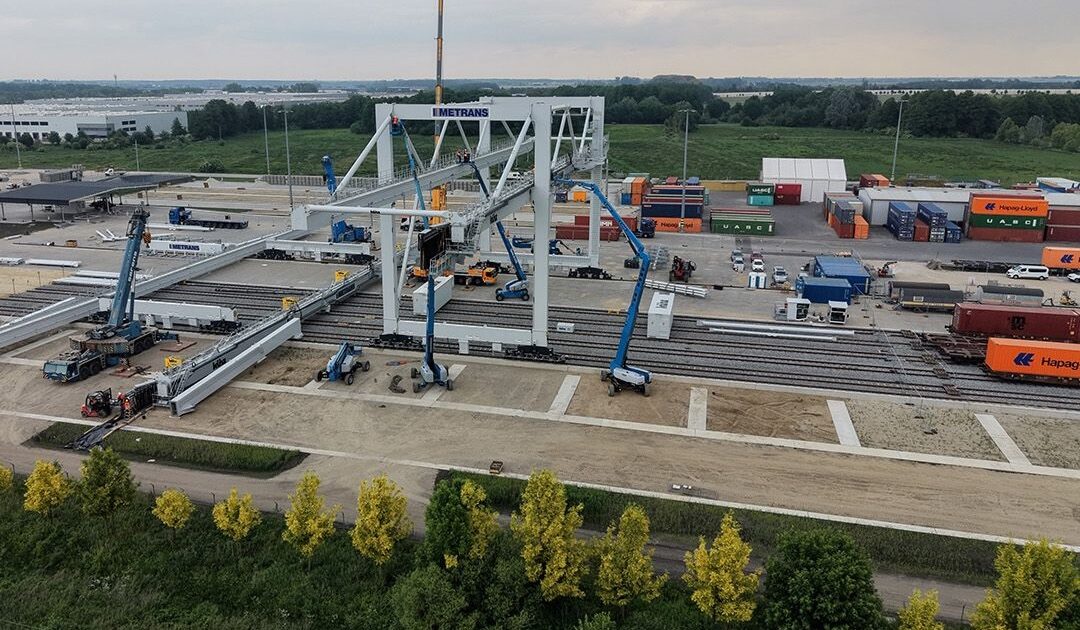
METRANS will launch a direct rail freight connection between its terminal in Dąbrowa Górnicza, Poland, and Žilina, Slovakia, starting 14 April 2026.

METRANS will launch a direct rail freight connection between its terminal in Dąbrowa Górnicza, Poland, and Žilina, Slovakia, starting 14 April 2026.
Port dues and tariffs in Ukraine remain among the highest in the Black Sea region and globally compared to other ports, according to Mauro Longobardo, CEO of ArcelorMittal Kryvyi Rih. He stated that freight costs continue to rise, but the company has not received any signals about a sharp increase in port tariffs. Meanwhile, the current level of port dues already significantly exceeds those of many foreign ports.
The Port of Rotterdam Authority intends to accelerate the development of hydrogen energy import infrastructure, but investment decisions on terminal construction are currently being delayed. To identify key challenges and potential solutions, the port held consultations with market participants. These consultations revealed that companies face a number of financial and non-financial risks that are hindering investment in import terminals and conversion facilities for hydrogen carriers such as ammonia.
Gebrüder Weiss, the international transport and logistics company, closed the 2025 financial year with net revenue of €2.73 billion, slightly exceeding the 2024 figure of €2.71 billion. Despite the weak economic situation in Europe, the company managed to strengthen its market position and improve productivity. According to CEO Wolfram Senger-Weiss, Europe remains the key region for the company’s business, but the company is also actively expanding its network in fast-growing global markets. Gebrüder Weiss’s financial strength is demonstrated by its high equity ratio of over 60%, and its workforce remained at approximately 8,600.
Swiss Federal Railways (SBB) reported an annual profit of CHF 496m (EUR 510m) for 2025, up from CHF 275m a year earlier, as average daily ridership reached a record 1.43 million passengers. Punctuality in passenger services improved to 94.1%, compared with 93.2% in 2024.
International port and logistics operator DP World reported record financial results for the full year 2025. Revenue grew 22% to $24.4 billion, while adjusted EBITDA increased 18% to $6.4 billion, with a margin of 26.3%. The growth was primarily driven by strong performance in the ports and terminals divisions, as well as the logistics business. Total group gross cargo throughput increased 5.8% to 93.4 million TEU.
Globalization remains at a historically high level despite rising geopolitical tensions, increased US tariffs, and uncertainty in global trade policy. This is the conclusion reached by experts in the new DHL Global Connectedness Report 2026, prepared jointly by DHL and the Stern School of Business at New York University. The report is based on an analysis of over 9 million indicators of international trade, capital, information, and people flows. According to analysts, the level of globalization in 2025 will be 25% on a scale from 0 to 100%—the same as the record year of 2022. Moreover, global trade turnover in 2025 will grow faster than any year since 2017 (excluding the pandemic), fueled in particular by shipments of goods related to the development of artificial intelligence.
Logistics company METRANS, part of Hamburger Hafen und Logistik AG (HHLA), has completed the acquisition of a 50% stake in the Afluent multimodal terminal in Arad, Romania, located near the border with Hungary. The investment is aimed at strengthening the company’s position in the multimodal transportation market in Southeastern Europe.
German companies are increasingly facing uncertainty in their economic relations with the United States. This is evidenced by the results of the “Going International 2026” study conducted by the German Chamber of Commerce and Industry (DIHK), which surveyed nearly 2,400 companies operating internationally. According to the survey, 67% of companies cite trade and political uncertainty as the main challenge in working with the US market. Other key factors include rising customs and bureaucratic costs (54%), financial market instability and currency risks (48%), the possible introduction of a 15% basic tariff (44%), and US export restrictions and sanctions affecting third countries (41%).
The Port of Rotterdam is seeing significant changes in the structure of global container trade by the end of 2025. According to data from the Port Authority and analysis presented in the Container Market Outlook 2026 report, container imports continue to grow, while exports remain weak, exacerbating the imbalance in the shipping system. Despite growing geopolitical and logistical challenges, Rotterdam maintains its status as Europe’s largest container hub. As Frank van der Laan, Senior Advisor for Business Analytics at the Port Authority, noted, these changes are already impacting cargo volumes, the structure of trade flows, and the functioning of the port system.