

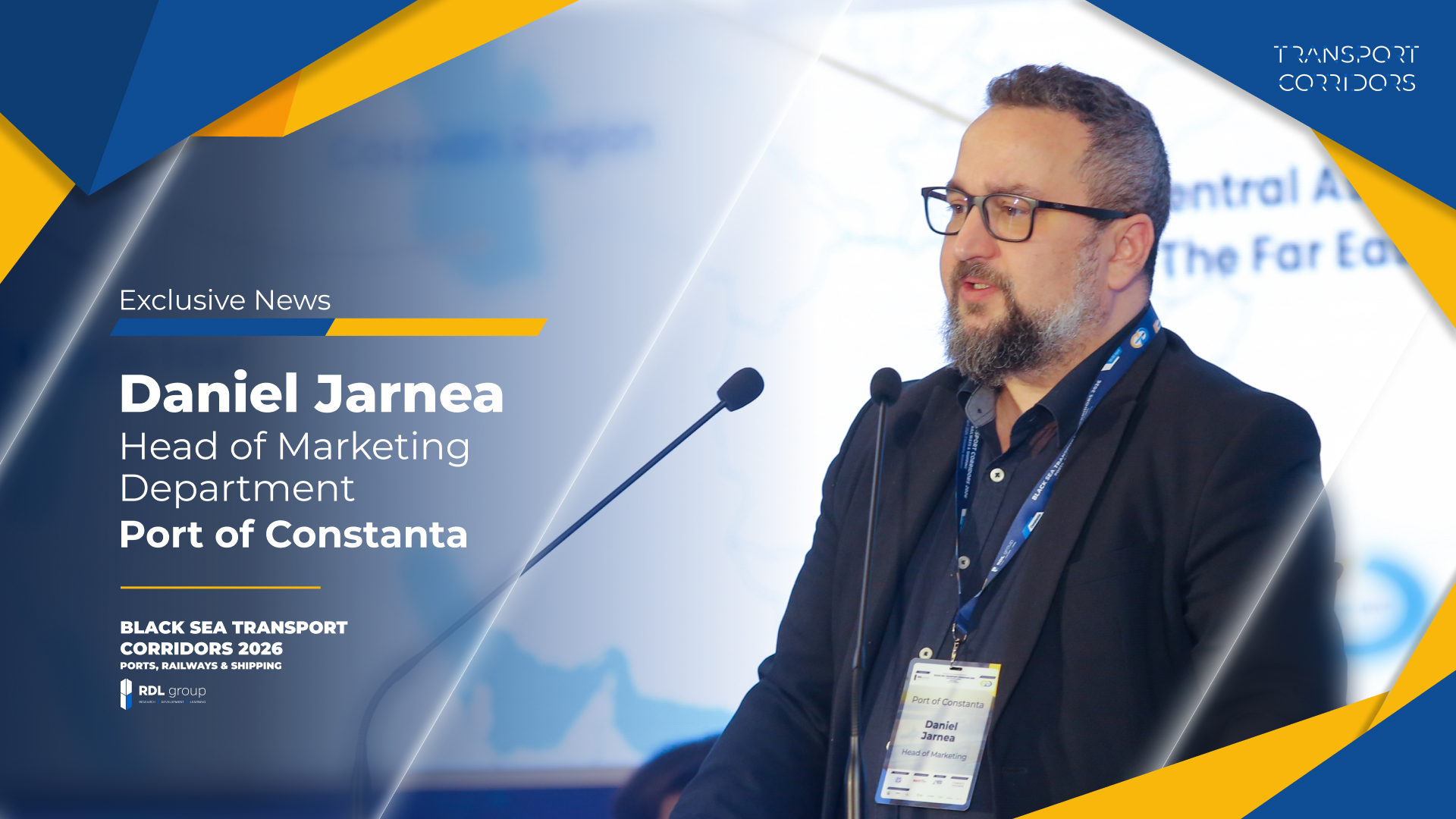
Head of Marketing at the Port of Constanța, Daniel Jarnea, at the BLACK SEA TRANSPORT CORRIDORS 2026: PORTS, RAILWAYS, SHIPPING conference presented a strategic overview of the port’s development as a central hub linking the Rhine-Main-Danube waterway with the new Baltic–Black Sea–Aegean corridor. A key message was the positioning of Constanța as the primary export hub for Ukrainian cargoes and a crucial link in the Middle Corridor.
The Port of Constanța holds a unique geographical advantage, located at the intersection of two strategic corridors. Of particular importance is the 64-kilometer canal with a depth of 7 meters and bridge clearance of 17.5 meters. Thanks to this infrastructure, 80–90% of grain reaches the port by barge. A convoy from Belgrade consisting of one pusher and six barges, each with a capacity of 2,000 tons, transports nearly 10,000 tons in a single voyage. This volume is equivalent to 300 trucks or 200 rail wagons, making inland waterways the undisputed leader in both environmental efficiency and cost-effectiveness.
Since 2018, the port has consistently handled over 60 million tons. In 2022, amid the shutdown of Odesa’s facilities, throughput reached 75 million tons, approaching the design capacity of 92.7 million tons. Despite an adjustment to 77 million tons in 2023, the port launched a major expansion program. The medium-term PSC project will provide 190 hectares of new land and increase operational capacity by 20% (up to 120 million tons per year). The long-term “Artificial Island” project, covering 460 hectares with depths of 20–21 meters, will form the foundation for future growth. A key pillar remains the Three Seas Initiative, including the Rail-2-Sea project – a railway connection from Gdańsk to Constanța through four countries.
“Inland waterways are undoubtedly number one. It is more environmentally friendly: you don’t use 300 trucks but cover long distances with the same fuel volume. In the context of the Suez crisis, which adds 20 days to routes around Africa, the Middle Corridor and Constanța are becoming critically important EU gateways.”