

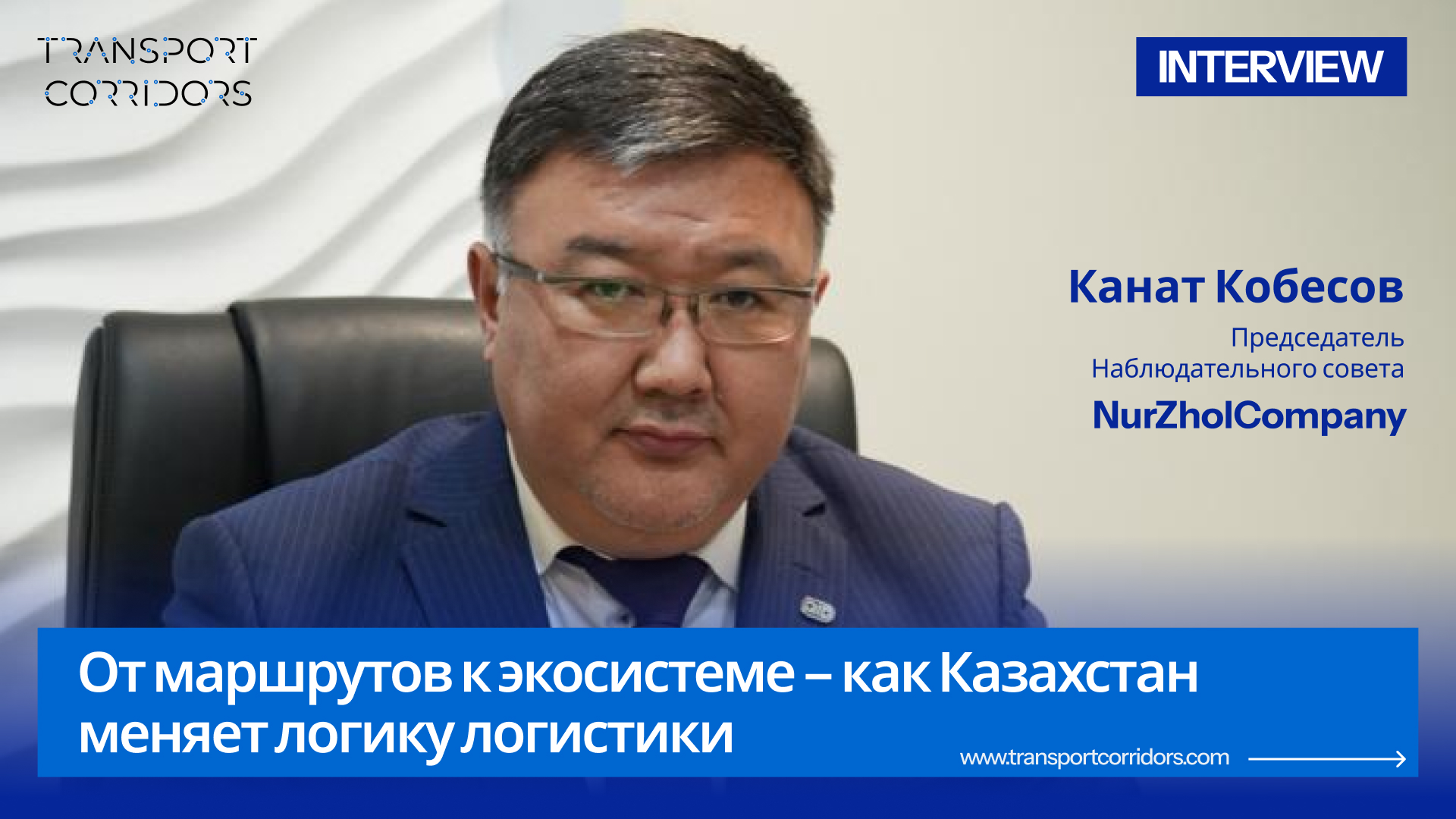
Kazakhstan is increasingly mentioned in the context of the Middle Corridor, transit routes between Europe and Asia, and digital logistics solutions. But behind these phrases lies a much deeper process – a shift in the very philosophy of logistics in the country. We spoke with Kanat Kobesov, a transport logistics expert who observes the industry’s transformation not in theory but in daily practice, about the systemic challenges that still remain, what has already changed, and why in a few years Kazakhstan will be perceived as a logistics hub rather than merely a transit territory.
Is there a systemic problem in Kazakhstan’s export logistics that everyone knows about but is difficult to change?
Before answering, Kanat Kobesov suggests looking back and comparing what the industry looked like just five years ago with how it looks today. The conversation now begins not with problems, but with dynamics.
“If we are honest, systemic challenges do exist. Five years ago, export logistics largely depended on a single direction, infrastructure could not keep pace with ambitions, and digitalization was fragmented. Today, the situation is fundamentally different. Kazakhstan is developing alternative routes, including the Trans-Caspian, expanding terminal capacity, and shifting from managing individual operations to managing supply chains.
In a few years, we will see an integrated flow management system where digital solutions become the standard. So this is no longer a dead end, but a stage of growth.”
What is more difficult today – building a transport route or aligning the interests of all supply chain participants?
Here the discussion shifts from geography to people and coordination. According to Kanat, the very nature of logistics challenges has changed.
“Previously, the main question was ‘how to deliver?’. There were few routes. Now there are more routes, and technologies allow us to quickly calculate the optimal path. The key difficulty today lies in synchronizing participants. There is a growing understanding of the need for end-to-end solutions, integrators and multimodal operators are emerging, and the role of long-term partnerships is increasing. In the coming years, the market will compete not by segments, but by logistics chains as a product.”
If you could relaunch one element of Kazakhstan’s logistics system, what would you change first and why?
Kanat’s answer is unexpected, as he notes that this “relaunch” is already effectively underway.
“The strategic priority has already been defined – integration and digitalization. Previously, each participant worked within their own system, with almost no data transparency. Now electronic document flow is developing, the role of logistics hubs is strengthening, and digital solutions are being implemented.
The next step is a full-fledged digital corridor and a ‘single window’ principle for exporters. This is already a realistic and achievable direction.”
In your opinion, what ‘invisible’ mistake in logistics today could become critical for the industry in 5–10 years?
Here Kanat focuses not on roads or terminals, but on information.
“The main risk is underestimating the role of data and standards. Previously, data was fragmented and processes were manual. Today, there is active digitalization and the introduction of platform solutions.
In a few years, the speed of information processing will become as important as physical infrastructure. Those who fail to integrate into global digital ecosystems will fall behind. This risk is already recognized, and steps are being taken to manage it.”
How is Kazakhstan’s role in transit corridors between Europe and Asia changing – strengthening its position or losing flexibility?
According to Kanat, this transformation is noticeable even to outside observers.
“Kazakhstan used to be perceived as a transit territory dependent on a single corridor. Now the country is becoming a key element of the Middle Corridor, new logistics nodes are forming, and international players are showing growing interest.
In a few years, Kazakhstan will not simply pass cargo through, but will manage flows and create added value through consolidation and services. This is a shift from being a bridge to becoming a logistics center of the region.”
In logistics, what is more difficult: infrastructure, tariff policy, or the human factor and the ability of participants to reach agreements?
“Historically, the most difficult aspect was the human factor – insufficient coordination and short-term thinking. But now dialogue between business and the government is intensifying, industry platforms are emerging, and a culture of partnership is forming. In the future, the market will become more institutionalized and decisions more predictable.”
Looking at the industry honestly: where is there more growth potential today – grain exports, transit, or digitalization of processes?
Summing up, Kanat suggests viewing the industry systemically.
“Growth is occurring in all areas, but at different speeds. Grain exports remain a stable strength. Transit shows the fastest dynamics amid geopolitical changes and requires high-quality service. But the key driver of transformation is digitalization, which reduces costs and increases speed.
If we compare: yesterday logistics was a set of operations, today it is a system, and tomorrow it will be a managed ecosystem. Kazakhstan has already passed the critical transition point.”
The conversation with Kanat Kobesov shows that Kazakhstan has already moved beyond the point where logistics was perceived as a supporting function. Today, it is becoming a tool for the country’s strategic positioning in Eurasia.
Logistics in Kazakhstan is no longer just a set of routes, tariffs, and infrastructure projects. It is gradually transforming into a system where coordination between participants, digital solutions, and the ability to manage flows across the entire supply chain play a key role. These changes are shaping the country’s future position in Eurasian trade.
Read more expert opinions, interviews, and analysis on the development of transport corridors between Europe and Asia on the TransportCorridors.com portal. We continue our series of discussions with key market participants in logistics and transit to show first-hand how the region’s logistics landscape is transforming, which solutions are already working in practice, and which trends will define the development of transport corridors in the coming years.
Join RDL group`s next conference, the CENTRAL ASIA TRANSPORT, LOGISTICS & INVESTMENT FORUM 2026, which will take place on July 9–10 in Astana. It will become an international platform for ports, railways, logistics operators, investors, and cargo owners interested in developing transport corridors and the transit potential of Central Asia.