

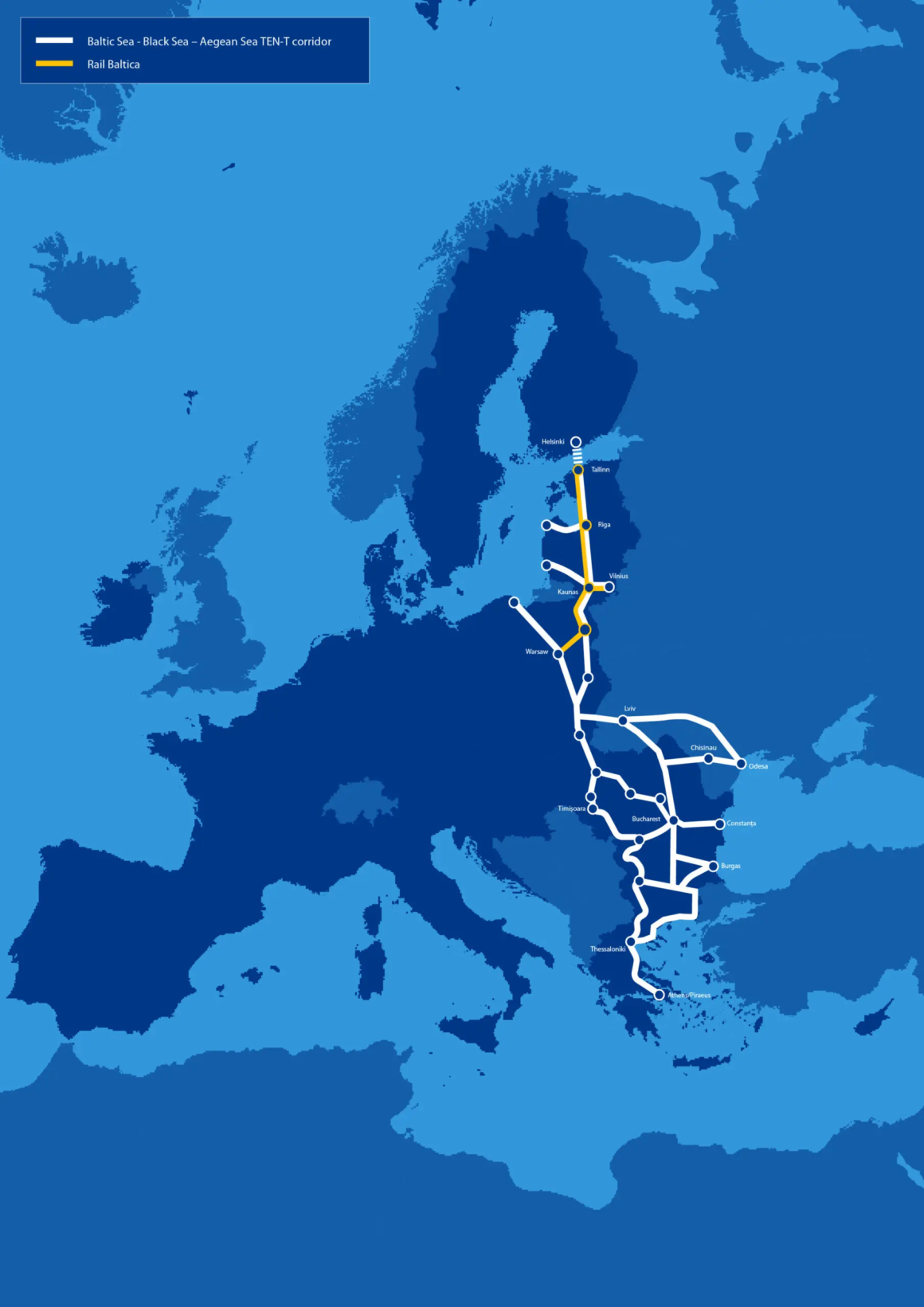
On March 17, Rail Baltica representatives participated in a meeting of countries along the Baltic Sea-Black Sea-Aegean Sea TEN-T transport corridor, where they presented the project’s progress and key management decisions. The discussion was moderated by Mario Mauro, the corridor’s European coordinator, who emphasized that effective governance remains a key factor in the successful implementation of cross-border infrastructure and allows countries to exchange experiences in project planning and implementation.
Rail Baltica was presented as an example of a complex international project spanning four countries and three cross-border connections, significantly exceeding the scale of typical initiatives. An additional challenge is that the project is being implemented from scratch and involves the introduction of high-speed rail and modern European technologies in a region where such systems were previously lacking. To coordinate the project, Estonia, Latvia, and Lithuania have created a joint company, RB Rail, which is responsible for strategic planning, system compatibility, and procurement, while national entities handle infrastructure construction and management.
RB Rail notes that centralized planning and quality control must be accompanied by a clear assignment of tasks and realistic timeline and budget estimates. As the project develops, management approaches require adaptation, as well as a constant review of roles and responsibilities. Particular attention is paid to risk management, alternative funding planning, and maintaining public support through transparent communication, given that such projects are implemented over several political cycles and require stability of key parameters throughout.